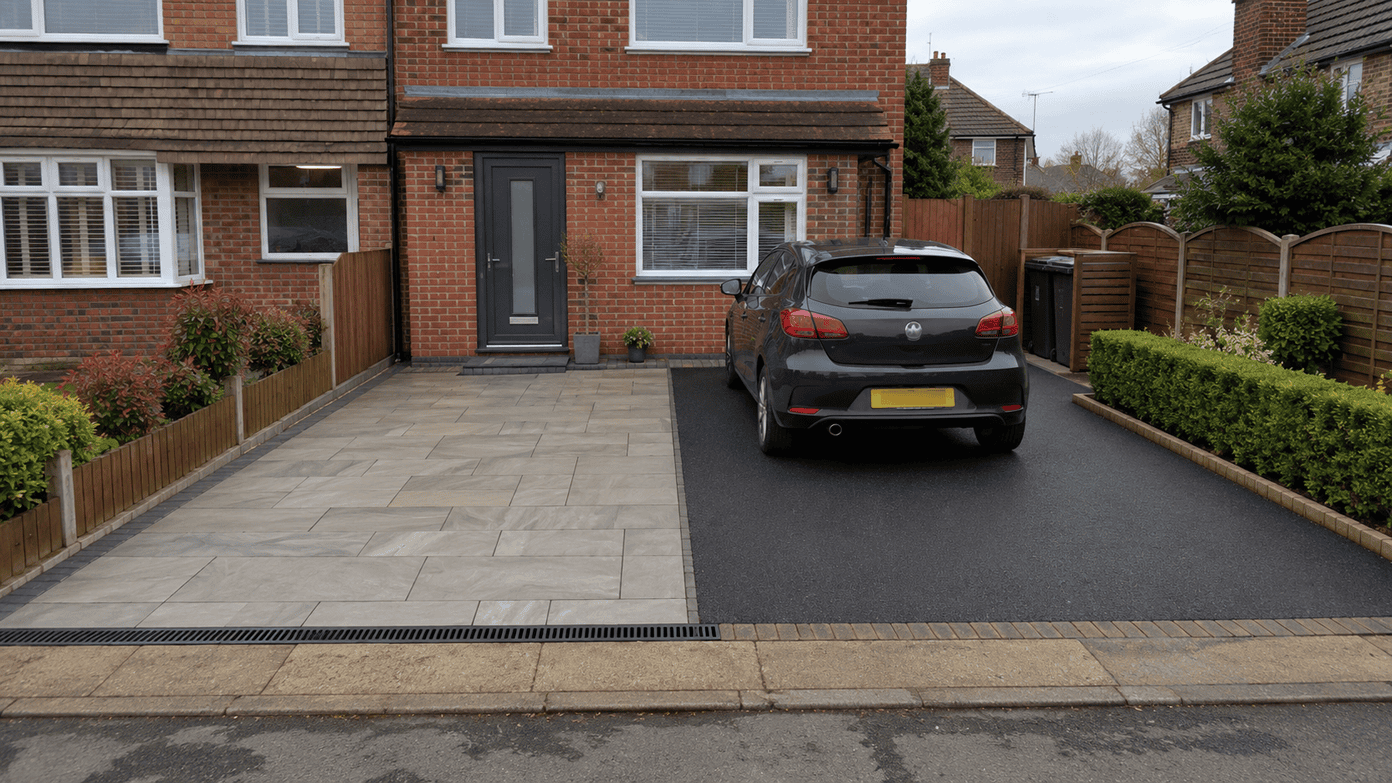


Resin driveways have become a familiar sight outside homes across the UK. Their neat finish, wide choice of colours and relatively simple maintenance make them an attractive alternative to loose gravel, concrete, block paving and tarmac.
However, the term “resin bond driveway” can cause some confusion. Homeowners often use it to describe any driveway made with resin and decorative stone. In fact, resin-bound and resin-bonded surfaces use different installation methods and do not perform in quite the same way.
For most residential driveways, the smooth stone-carpet appearance people have in mind is a resin-bound driveway. Resin-bonded surfacing has a rougher, more textured finish that looks closer to loose gravel. Understanding that distinction makes it easier to compare quotations and choose a suitable specification.
What Is a Resin Driveway?
A resin driveway combines clear resin with natural or coloured aggregate. The result is a decorative hard surface that can suit both traditional and modern British homes.
Installers can use resin and stone in two main ways:
| Type of surface | How it is installed | Typical finish | Permeable? |
|---|---|---|---|
| Resin bound | The aggregate and resin are mixed together before being hand-trowelled onto the base | Smooth, even and seamless | It can be permeable when installed over a suitable open-graded base |
| Resin bonded | Resin is spread over the base before loose aggregate is scattered onto it | Rougher, with a loose-gravel appearance | Usually no |
The two names sound very similar, so it is easy to mix them up. Nevertheless, the difference affects drainage, maintenance, comfort underfoot and the type of base required.
Resin-bound surfacing is generally the more common choice for domestic driveways, paths and patios. Resin-bonded surfacing may suit areas where a highly textured, traditional gravel appearance is wanted, although some loose stones can remain after installation.
Why Are Resin Driveways So Popular in the UK?
No single feature explains their appeal. Instead, resin driveways combine an attractive appearance with practical benefits that suit many British properties.
They create a smart, seamless finish
Resin-bound aggregate forms a continuous surface without the regular joints found in block paving or paving slabs. This can make a front garden look tidier and, in some cases, more spacious.
The surface also works around curves, steps, inspection covers and awkwardly shaped boundaries. As a result, homeowners can create a made-to-measure layout rather than designing the driveway around standard paving sizes.
There is a wide choice of colours
Aggregates come in many natural-looking blends, from pale gold and warm brown to silver, grey and charcoal. A homeowner can therefore select a finish that complements the brickwork, roof tiles, render or surrounding landscaping.
Contrasting colours can also form borders, pathways or parking bays. However, simple designs often age better than complicated patterns. A neutral main colour with a subtle border usually works well on an ordinary UK home.
A correctly designed resin-bound driveway can drain well
Surface-water management has become an important part of front-garden design. A fully permeable resin-bound system allows rainwater to pass through the surface and into a suitable porous base below.
This does not mean that every resin driveway is automatically permeable. The resin surface, base construction, ground conditions and drainage design must all work together. Laying permeable resin over an impermeable concrete base does not create a fully permeable driveway.
In England, government guidance on permeable front-garden surfacing says that paving more than five square metres of a front garden with an impermeable surface may require planning permission unless water drains to a permeable area. A properly designed permeable driveway can therefore offer a useful advantage. Rules and local requirements can vary, so homeowners should check with their council where necessary.
Resin-bound surfaces are comfortable to walk on
A well-laid resin-bound surface feels firm and relatively smooth. There are no loose stones to track into the house, and the even finish can be helpful for pushchairs, wheelchairs, bicycles and bins.
Installers can also incorporate an appropriate anti-slip aggregate where required. Even so, no outdoor surface remains completely slip-proof. Leaves, algae, frost and poor maintenance can still make a driveway slippery.
Maintenance is usually straightforward
Resin-bound driveways do not need regular joint re-sanding in the same way as some block-paved areas. Weeds are also less likely to grow through a correctly installed seamless surface.
Routine care normally includes sweeping away leaves, removing moss or algae and washing the surface occasionally. Any weeds that appear often come from wind-blown seeds taking root in collected dirt rather than growing through the full construction.
Low maintenance does not mean no maintenance. Oil spills should be dealt with promptly, drainage channels need clearing and pressure washing must be carried out carefully with suitable equipment.
The surface can improve kerb appeal
A faded, cracked or patchy driveway can dominate the front of a property. Resin surfacing provides a clean and coordinated finish, especially when the installer also renews edging, steps and drainage.
Kerb appeal is difficult to value precisely, and a new driveway does not guarantee that a home will sell for more. Still, a tidy entrance can create a better first impression for visitors and potential buyers.
Resin Bound Versus Other Driveway Materials
Every driveway material has advantages and drawbacks. The right choice depends on the property, budget, drainage and preferred appearance.
| Material | Main advantages | Points to consider |
| Resin bound | Seamless appearance, colour choice, easy access and potential permeability | Requires skilled installation and a sound base |
| Block paving | Individual blocks can be replaced; many patterns available | Joints may collect weeds and require maintenance |
| Tarmac | Practical, familiar and suitable for larger areas | Fewer decorative choices and repairs may remain visible |
| Gravel | Usually economical and naturally drains well | Stones move, migrate and can be difficult for wheels |
| Concrete | Strong and straightforward | Plain concrete can look utilitarian and may crack |
| Paving slabs | Attractive choices for paths and patios | Not every slab or installation method suits vehicle traffic |
A resin-bound driveway can provide a useful middle ground. It offers more decorative choice than standard tarmac, yet it has a more stable surface than loose gravel. On the other hand, its performance depends heavily on preparation and installation quality.
Can Resin Be Laid Over an Existing Driveway?
Sometimes. A contractor may be able to install a resin-bound surface over sound concrete or tarmac. This can reduce excavation, waste and labour. However, the existing driveway must be stable, clean and suitable for the proposed system.
Cracks, movement, poor falls and drainage problems should not simply be covered. Any defects underneath may eventually affect the new finish. Furthermore, an impermeable existing base will normally mean the complete construction remains impermeable, even if the resin-bound layer itself allows water through.
Loose gravel, badly broken concrete, contaminated surfaces and weak block paving usually need more extensive preparation or removal. A reputable installer should inspect the base before confirming whether an overlay is sensible.
What Makes a Good Resin Driveway Installation?
The attractive top layer is only one part of the job. Long-term performance starts below the surface.
A suitable and stable base
Vehicle traffic places repeated loads on the driveway. Therefore, the sub-base and base must suit the ground conditions and expected use. A weak base can move, sink or crack, taking the resin surface with it.
Correct drainage and levels
Water should not run towards the house, neighbouring land or the public highway. The contractor should plan falls, permeable construction, drainage channels and discharge points before work begins.
Quality resin and compatible aggregate
Driveway-grade materials should suit external use. UV-stable resin can help pale aggregates retain their intended appearance, while the stone should be clean, dry and correctly graded.
Accurate mixing and consistent trowelling
Resin systems have limited working times. Installers must measure batches accurately, mix them thoroughly and trowel the material to a consistent depth. Poor timing or uneven application can lead to colour changes, weak patches or visible joins.
Suitable weather conditions
Rain and moisture can interfere with installation. Very high or low temperatures may also affect working and curing times. An experienced contractor will monitor the forecast and avoid laying the surface in unsuitable conditions.
Possible Drawbacks to Consider
Resin driveways are popular, but they are not automatically the best option for every property.
- A high-quality installation may cost more than basic gravel or standard tarmac.
- The surface is difficult to install well as a DIY project.
- Repairs can show if the original stone blend has changed or weathered.
- A poor base can cause cracking, sinking or separation.
- Light colours may show tyre marks and dirt more readily.
- Resin-bonded surfaces may shed some loose aggregate.
- A resin-bound top layer is not fully permeable if the construction beneath it blocks water.
These drawbacks are manageable when the design suits the site and the installer follows the correct specification. Problems often arise when quotations omit preparation or promise that resin can cover almost any existing surface.
How Long Does a Resin Driveway Last?
There is no single lifespan for every resin driveway. Traffic levels, base quality, drainage, materials, installation and maintenance all make a difference.
A professionally installed system should provide many years of use. However, homeowners should be cautious about any promise that focuses only on the resin layer while ignoring the base. The complete build-up determines how well the driveway handles vehicle weight, weather and ground movement.
Ask each contractor what guarantee applies, who provides it and what it covers. A product warranty may not cover poor groundwork or incorrect installation, while an installer guarantee may contain maintenance conditions and exclusions.
How Much Does a Resin Driveway Cost?
Driveway prices depend on the driveway size, access, ground conditions, drainage and whether the existing base can remain. Consequently, a simple overlay onto sound tarmac can cost much less than a full excavation and rebuild.
Important cost factors include:
- excavation and removal of waste;
- new sub-base and base materials;
- drainage channels or soakaway work;
- edging blocks and steps;
- the resin and aggregate specification;
- manhole-cover alterations;
- restricted access and hand excavation;
- the total area and shape of the driveway.
Rather than comparing only a price per square metre, homeowners should compare the complete scope. A cheap quote that excludes excavation, drainage or an appropriate base may not represent good value.
Do Resin Driveways Need Planning Permission?
Planning rules depend on where the property is located and how water will be managed. In England, a new or replacement front driveway of any size normally does not need planning permission when it uses permeable surfacing or directs water to a lawn or border where it can drain naturally. An impermeable front driveway covering more than five square metres may require permission if it does not provide that drainage.
Those rules apply to houses and may not apply in the same way to flats, maisonettes, listed buildings or homes with restricted permitted development rights. Scotland, Wales and Northern Ireland also have their own planning systems. In addition, creating or widening access across a pavement normally requires approval for a dropped kerb from the relevant highway authority.
It is sensible to confirm the position with the local council before work starts, especially if the design changes levels, boundaries, drainage or access to the road.
How to Compare Resin Driveway Quotes
A detailed quotation makes it easier to judge whether installers are offering the same standard of work.
1. Confirm the type of resin surface
Ask whether the quotation is for resin-bound or resin-bonded surfacing. The wording should be clear and should match the finish and drainage performance you expect.
2. Ask what happens to the existing driveway
The contractor should state whether the old surface will remain, receive repairs or be excavated. If an overlay is proposed, ask why the base is suitable.
3. Compare the full construction
Check the proposed sub-base, base, resin system, aggregate and finished depth. Also look for edging, drainage and waste removal rather than relying on a headline square-metre rate.
4. Discuss drainage and permissions
Ask where rainwater will go and whether the complete construction is permeable. Confirm who will deal with any planning or dropped-kerb requirements.
5. Check previous work and protection
Request recent examples, customer references and evidence of appropriate insurance. You should also obtain written details of guarantees and aftercare.
6. Compare several written quotations
Prices alone do not show the quality of the base or materials. Comparing itemised quotes can reveal important differences in preparation, drainage and guarantees.
Is a Resin Driveway Right for Your Home?
A resin-bound driveway may suit homeowners who want a modern, tidy surface with a choice of natural stone colours. It can work particularly well where smooth access, low routine maintenance and controlled drainage are priorities.
Nevertheless, it needs the right foundations. A proper site survey should consider the existing surface, ground stability, vehicle use, levels and the route rainwater will take. If the site is unsuitable, block paving, porous asphalt, gravel or another material may provide better value.
Professional quotations should help you compare more than colour samples. Ask each installer to explain the complete construction and why it suits your property. That approach gives you a much better chance of receiving a driveway that looks smart and continues to perform.
Frequently Asked Questions
What is the difference between resin bound and resin bonded?
With resin-bound surfacing, the stone and resin are mixed before being trowelled onto the driveway. With resin-bonded surfacing, resin is spread first and loose stone is scattered over it. Resin bound usually has a smoother finish and can be permeable as part of a correctly designed system. Resin bonded feels rougher and is normally impermeable.
Why are resin driveways popular in the UK?
They offer a neat appearance, many aggregate colours, a stable surface and relatively simple maintenance. A properly designed resin-bound system can also allow water to drain through, which suits the UK’s need to manage surface-water runoff.
Are resin driveways permeable?
Resin-bound surfacing can be permeable, but the complete construction must include a suitable porous base and drainage design. Resin-bonded surfacing is generally impermeable. A permeable top layer laid over solid concrete does not make the whole driveway permeable.
Can weeds grow through a resin driveway?
Weeds should not normally grow through a correctly installed resin-bound surface and stable base. However, seeds can settle in dirt on top and begin growing, so regular sweeping and cleaning still matter.
Can a resin driveway be laid over concrete or tarmac?
It may be possible when the existing surface is sound, stable and properly prepared. Cracked, moving or poorly drained bases may need repairs or full replacement. An overlay on an impermeable base will not create a fully permeable driveway.
Does a resin driveway need planning permission?
In England, a permeable front driveway or one that directs water to a permeable area will not normally need planning permission. An impermeable surface larger than five square metres may require it. Different rules or restrictions can apply, so check with the local planning authority.
Are resin driveways slippery?
A textured resin-bound finish can provide useful grip, and installers may add anti-slip material. Even so, leaves, algae, ice and poor maintenance can make any outdoor surface slippery.
How should I clean a resin driveway?
Sweep it regularly and remove leaves before they break down. Occasional gentle washing can lift ordinary dirt. Treat moss, algae and oil with products and methods approved by the installer, and avoid using excessive pressure close to the surface.