

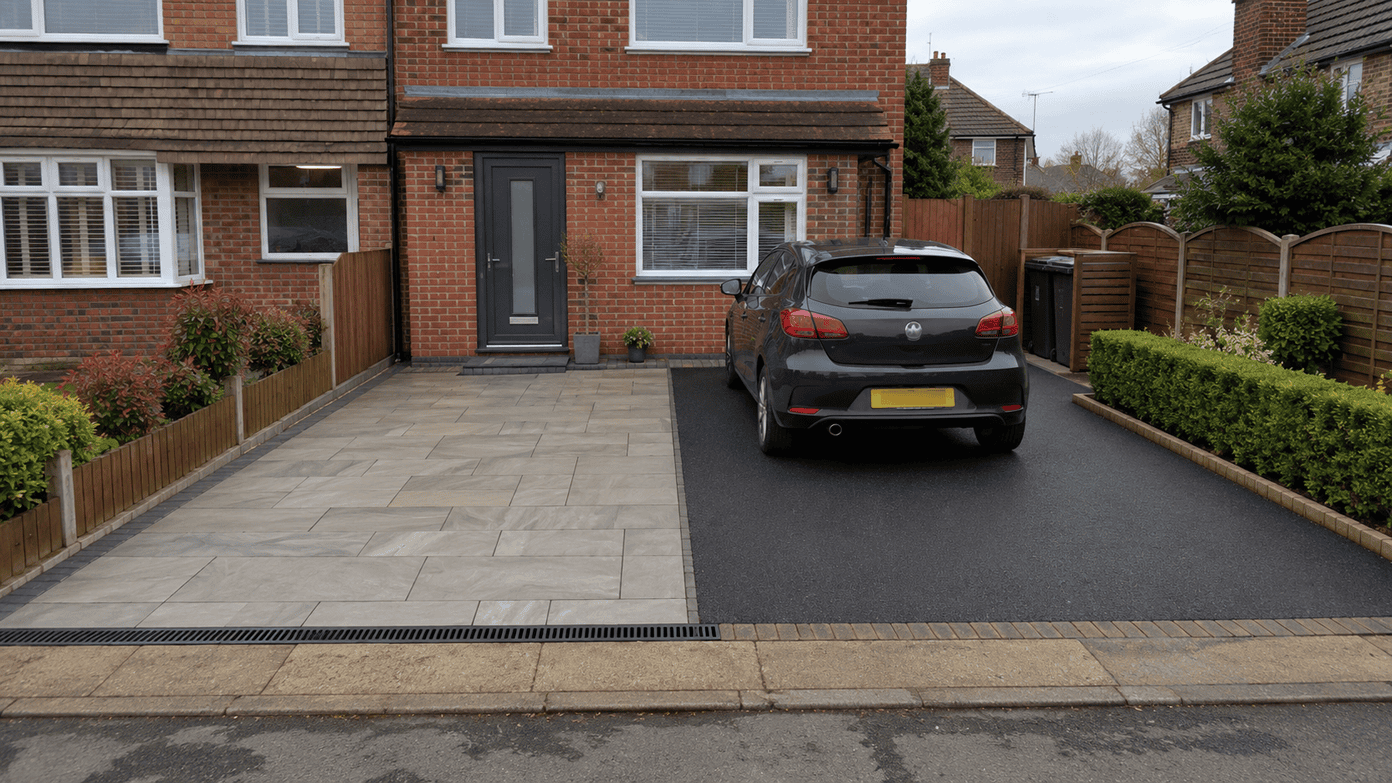
When converting a front garden into a driveway, two of the most common options are asphalt and slab paving.
Both can create a practical parking area, but they suit different budgets, property styles and maintenance expectations.
Asphalt, often called tarmac in everyday UK use, creates a smooth continuous surface. It is usually quick to install, relatively affordable and particularly useful for simple one-car or two-car driveways.
Slab paving offers far more choice in colour, size and appearance. Depending on the product, slabs can create anything from a traditional sandstone-style frontage to a very modern porcelain or large-format concrete driveway.
However, not every patio slab is suitable for vehicles. Driveway slabs need to be specifically designed for vehicle loading and installed on an appropriate base.
For many homeowners, the decision comes down to this: asphalt is usually the simpler and more economical option, while properly specified driveway slabs provide greater design flexibility and a more premium appearance.
This guide compares asphalt and slab paving for UK front gardens and driveways, including costs, maintenance, drainage, repairs and installation requirements.
Asphalt vs Slab Driveways at a Glance
| Feature | Asphalt | Driveway Slabs |
|---|---|---|
| Initial cost | Usually lower | Usually higher |
| Installation speed | Fast | Slower |
| Appearance | Simple and uniform | Wide design choice |
| Colour choice | Mostly black, some specialist colours | Very wide |
| Pattern choice | Limited | Extensive |
| Maintenance | Low | Low to moderate |
| Weeds | Few joints | Depends on jointing |
| Local repairs | Straightforward but visible | Individual slabs may be replaceable |
| Settlement visibility | Can create dips and cracks | Individual slabs may move or rock |
| Heavy vehicle suitability | Very good with correct base | Good with vehicle-rated slabs and base |
| Drainage | Standard asphalt normally impermeable | Permeable systems possible |
| Small driveway suitability | Excellent | Excellent |
| Traditional property | Functional but less traditional | Natural stone-style slabs can suit well |
| Modern property | Clean and simple | Large-format slabs can look premium |
| Installation labour | Moderate | Higher |
| Future matching | Usually straightforward patching | Matching discontinued slabs can be difficult |
What Do We Mean by Asphalt?
Modern asphalt driveways use aggregate bound together with bitumen.
A typical driveway may consist of:
- Excavated formation.
- Compacted granular sub-base.
- Asphalt binder course.
- Asphalt surface course.
- Kerb or block edging.
- Drainage where required.
The finished surface is usually black when new and gradually weathers towards dark grey.
Although many contractors call it tarmac, most modern domestic surfacing is asphalt or a related bitumen-bound material rather than traditional tar-bound tarmacadam.
What Do We Mean by Slab Paving?
Slab paving uses larger individual paving units rather than small block pavers.
Potential driveway slab materials include:
- Concrete
- Porcelain
- Natural stone
- Granite
- Sandstone
- Limestone
- Reconstituted stone
However, driveway paving must be specifically rated for vehicle use.
Standard garden patio slabs are not automatically suitable.
Patio Slabs vs Driveway Slabs
This distinction is extremely important.
A slab may look strong but still be designed only for pedestrian use.
Vehicle-rated paving usually needs suitable:
- Thickness
- Strength
- Bedding system
- Jointing
- Sub-base
- Edge restraint
Using ordinary thin patio slabs on a driveway can lead to:
- Cracking
- Rocking
- Snapped corners
- Settlement
- Movement under steering tyres
Always check the product manufacturer’s intended use.
Which Is Cheaper: Asphalt or Slabs?
Asphalt is normally cheaper for a complete driveway.
A straightforward asphalt installation can cover a relatively large area quickly using mechanical equipment.
Slab paving requires considerably more individual handling.
Each slab may need:
- Setting out
- Cutting
- Lifting
- Bedding
- Levelling
- Jointing
Therefore, labour costs are generally higher.
Typical UK Driveway Costs
The following are broad budgeting ranges rather than fixed prices.
| Driveway Type | Typical Installed Cost |
| Basic asphalt driveway | £60–£100 per m² |
| Higher-spec asphalt | £90–£140+ per m² |
| Basic concrete driveway slabs | £80–£130 per m² |
| Decorative concrete slabs | £100–£160 per m² |
| Vehicle-rated porcelain | £120–£200+ per m² |
| Natural stone driveway slabs | £120–£220+ per m² |
| Premium granite or stone | £150–£250+ per m² |
Complex excavation, drainage, retaining walls and restricted access can push either option above these ranges.
Example Costs for a 40m² Driveway
| Surface | Broad Budget |
| Asphalt | £3,000–£5,500 |
| Concrete driveway slabs | £3,500–£6,000 |
| Decorative slabs | £4,500–£7,500 |
| Vehicle-rated porcelain | £5,500–£8,500+ |
| Natural stone | £5,500–£9,000+ |
These figures assume a relatively straightforward installation.
Why Asphalt Is Usually Cheaper
Asphalt installation is efficient once groundwork has been completed.
A contractor can:
- Deliver material in bulk
- Spread it rapidly
- Mechanically compact it
- Cover large areas with relatively few joints
Slab paving requires much more hand labour.
Even a small driveway might contain dozens of large units that all need placing individually.
Which Looks Better?
This is largely personal preference.
Asphalt
Asphalt creates a:
- Simple
- Dark
- Uniform
- Functional
- Uncluttered
appearance.
It often suits:
- Modern semi-detached houses
- New builds
- Large parking areas
- Narrow driveways
- Properties where budget matters
Slabs
Slab paving offers much more visual choice.
Possible styles include:
- Large grey porcelain
- Buff sandstone
- Granite-effect paving
- Smooth contemporary concrete
- Traditional stone
- Mixed-size paving
For homeowners prioritising appearance, slabs normally offer greater flexibility.
Asphalt with a Slab or Block Border
The two options do not need to be completely separate.
A popular compromise is:
- Asphalt central parking area
- Slab or block-paved border
- Decorative entrance apron
- Paved front path
This provides the lower cost of asphalt across most of the area while making the driveway look more considered.
Which Is Better for a Small Front Garden?
Both can work very well.
Asphalt often has an advantage where every centimetre matters because there are no wide decorative joints or complicated borders.
It provides one uninterrupted parking surface.
On the other hand, large-format slabs can visually make a small frontage feel more premium and less like a basic parking area.
For a compact property, keep either design relatively simple.
Which Makes a Small Driveway Look Bigger?
Simple surfaces usually work best.
Good choices include:
Asphalt
One uninterrupted dark surface can make an awkwardly shaped driveway look more coherent.
Large Slabs
Fewer joints can make the space feel less busy.
Avoid:
- Too many slab colours
- Multiple borders
- Complicated patterns
- Excessive decorative strips
These can make a small frontage feel even smaller.
Which Is Better for a Modern House?
Both can work.
Asphalt
Good for a minimalist look, especially with:
- Grey edging
- Black windows
- Rendered walls
- Modern fencing
Slabs
Large-format grey or charcoal paving can create a high-end contemporary appearance.
Vehicle-rated porcelain is particularly popular for modern designs.
Which Is Better for a Traditional House?
Slabs often provide more options.
Suitable styles might include:
- Sandstone
- Reconstituted stone
- Tumbled concrete
- Granite
- Traditional textured slabs
However, asphalt can still work well alongside an older property if combined with:
- Brick edging
- Stone borders
- Traditional walls
- Gravel planting areas
Asphalt Driveway Advantages
Lower Initial Cost
Asphalt is often one of the more economical permanent driveway surfaces.
Fast Installation
Once the base is prepared, laying the surface can be relatively quick.
Smooth Finish
It works well for:
- Cars
- Bicycles
- Pushchairs
- Wheelchairs
- Wheelie bins
Few Joints
There are fewer places for weeds to establish.
Suitable for Large Areas
Asphalt becomes particularly economical on larger driveways.
Good Load Distribution
A properly built asphalt structure handles regular vehicle traffic well.
Asphalt Driveway Disadvantages
Limited Appearance
Standard asphalt is usually black or dark grey.
Visible Repairs
New patches normally appear darker than the existing surface.
Edge Damage
Unsupported edges may crumble.
Heat Softening
Hot weather can make the surface more susceptible to tyre scuffing.
Fuel Damage
Petrol and some petroleum products can damage bituminous surfacing.
Standard Asphalt Is Usually Impermeable
Drainage therefore needs careful planning.
Slab Driveway Advantages
Greater Design Choice
Slabs are available in many:
- Colours
- Sizes
- Textures
- Materials
Premium Appearance
Well-designed slab paving can significantly improve a front garden.
Local Replacement
A damaged slab can sometimes be lifted and replaced individually.
Defined Areas
Different paving can mark:
- Parking bays
- Paths
- Bin areas
- Entrances
Natural Stone Options
Slabs can suit traditional and high-end properties particularly well.
Slab Driveway Disadvantages
Higher Cost
Materials and installation labour are normally more expensive.
More Joints
Joints can collect:
- Dirt
- Moss
- Weeds
depending on the system.
Individual Movement
Poorly installed slabs can:
- Rock
- Sink
- Crack
- Lift
Product Matching
If the slab is discontinued, future repairs may be difficult to match.
More Complicated Installation
Large heavy units need accurate bedding and cutting.
Which Lasts Longer?
Both surfaces can last for decades if installed properly.
Broad expectations may include:
| Surface | Broad Potential Lifespan |
| Asphalt | 15–25+ years |
| Concrete driveway slabs | 20–30+ years |
| Porcelain driveway paving | 25+ years |
| Granite slabs | 30–50+ years |
| Good natural stone | 30+ years |
The base often determines lifespan more than the visible surface.
Poor groundwork can cause an expensive slab driveway to fail surprisingly quickly.
Which Is Easier to Repair?
Each material has a different advantage.
Asphalt
Damage can normally be:
- Cut out
- Rebased
- Refilled
- Compacted
However, the patch may remain visible.
Slabs
Individual damaged slabs can sometimes be lifted and replaced.
This can create a neater repair if a matching slab remains available.
Asphalt Repair Appearance
Fresh asphalt is usually much darker than old asphalt.
An asphalt driveway repair may therefore be obvious initially.
It will normally weather and lighten with time, although it may never become completely invisible.
Slab Repair Appearance
A replacement slab may also stand out because:
- Existing slabs have faded
- Natural stone has weathered
- Old paving is stained
- New manufacturing batches differ
Keeping spare slabs from the original installation is very useful.
Which Is Better if the Ground Moves?
Neither will perform well on a poor base.
Asphalt is flexible and may tolerate slight movement better than rigid slab paving.
However, significant settlement can still cause:
- Cracks
- Depressions
- Rutting
Slabs may instead:
- Rock
- Sink
- Become uneven
- Crack
Good ground preparation is essential for both.
Sub-Base for Asphalt
A typical driveway may use:
- Compacted MOT Type 1 or another suitable granular sub-base
- Binder course
- Surface course
The exact depth depends on:
- Soil
- Vehicle loading
- Existing construction
- Drainage
Sub-Base for Slabs
Slab paving normally needs:
- Excavated formation
- Compacted granular sub-base
- Suitable bedding system
- Full support beneath each slab
- Strong edge restraints
The method varies according to the slab manufacturer.
Can Slabs Be Laid on Sand Like Block Paving?
Not all slab systems should be.
Some vehicle-rated slab systems have specific flexible-laying specifications. Others require rigid bedding.
Large porcelain and many natural stone slabs normally need a suitable full mortar bed or proprietary installation system.
Follow the paving manufacturer’s specification.
Why Full Support Matters
A driveway slab that is supported only at a few points may crack under a car.
Vehicle weight concentrates pressure beneath the tyres.
Full and consistent support helps spread this load into the base.
Which Is Better for Heavy SUVs?
Both can be suitable when correctly specified.
For large SUVs and vans:
Asphalt
Increase:
- Base strength
- Layer thickness
- Edge support
Slabs
Use:
- Vehicle-rated units
- Correct thickness
- Appropriate bedding
- Strong sub-base
- Secure edges
Avoid choosing paving based only on appearance.
Which Is Better for Vans?
Asphalt is often the simplest option for driveways regularly carrying vans.
The continuous surface handles loading well when the structure beneath it is suitably designed.
Heavy-duty slabs can also work, but the installation specification becomes particularly important.
Damage from Stationary Steering
Modern cars can place large twisting forces onto driveway surfaces when the steering wheel is turned while stationary.
This can affect both surfaces.
Asphalt
May suffer:
- Scuffing
- Twisting
- Small depressions
especially when hot or newly laid.
Slabs
May suffer:
- Movement
- Joint damage
- Cracked corners
if they are poorly supported.
Whenever practical, turn the steering wheel while the vehicle is moving slightly.
Which Is Less Slippery?
Both can provide good grip.
Asphalt
Its textured aggregate surface normally provides good traction.
Slabs
Slip resistance varies significantly.
Smooth polished slabs may become slippery when wet.
Choose external vehicle-rated paving with an appropriate surface texture.
Which Is Better in Frost?
Both can perform well.
Asphalt has no joints between individual units, while good-quality external slabs should be frost resistant.
Problems develop where:
- Water becomes trapped
- Drainage is poor
- Slabs are unsuitable for external use
- Weak joints deteriorate
Which Handles Rain Better?
This depends more on drainage design than surface type.
Standard asphalt and standard slab paving are often impermeable.
Rain needs to be directed towards:
- Permeable garden area
- Soakaway
- Drainage channel
- Suitable permeable system
Front Garden Drainage Rules in England
Current Planning Portal guidance states that a new or replacement front driveway does not normally need planning permission if it uses permeable surfacing, such as gravel, permeable block paving or porous asphalt, or if rainwater is directed to a lawn or border where it can drain naturally. If more than 5m² is covered with traditional impermeable surfacing and the water is not directed to a permeable area, planning permission is required.
These rules relate to houses in England and can be affected by planning conditions, Article 4 Directions or other restrictions. Different planning systems apply elsewhere in the UK.
Porous Asphalt
Porous asphalt allows rainwater to pass through the surface.
However, the entire construction needs to support drainage.
It normally requires:
- Permeable surface
- Open-graded base
- Suitable sub-base
- Water storage or infiltration
- Suitable underlying soil or drainage route
Simply using porous asphalt over an impermeable concrete slab does not create a properly permeable driveway.
Permeable Slab Paving
Some slab and paving systems are designed to manage rainwater.
These may use:
- Wider drainage joints
- Permeable bedding
- Open-graded sub-base
- Drainage cells
Again, the complete construction matters.
A permeable-looking joint does not compensate for an impermeable base underneath.
Drainage Channels
Both asphalt and slabs can use linear drainage channels.
Typical locations include:
- Across the driveway near the house
- Across the entrance
- In front of a garage
- Along the low edge
The channel still needs a suitable outlet.
Which Is Better Near the House?
Either can work if levels and drainage are correct.
Important considerations include:
- Damp-proof course
- Air bricks
- Door thresholds
- Garage floor level
- Surface falls
Avoid raising the driveway unnecessarily against the property.
Front Garden Appearance
Replacing an entire front garden with one large hard surface can make a property look harsh.
A good design can retain:
- Narrow planting border
- Small tree
- Hedge
- Gravel strip
- Planter
- Front path
This applies to both asphalt and slabs.
Asphalt with Planting
Dark asphalt can contrast well with:
- Green hedges
- Ornamental grasses
- Lavender
- Light gravel
- Brick walls
Even a narrow planting strip can soften the appearance.
Slab Driveway with Planting
Slabs allow borders and planting areas to be integrated easily.
For example:
- Large grey slabs
- Narrow gravel drainage strip
- Raised planter
- Matching front path
Try not to make the design overly complicated.
Which Is Better for Wheelie Bins?
Both provide a stable surface.
Slabs can make it easier to create a deliberately separate bin area.
Asphalt can simply continue beneath a timber or metal bin store.
Which Is Better with an EV Charger?
Both are suitable.
Plan the charger cable route before installing the driveway.
It may be useful to install:
- Underground ducting
- Electrical cable
- Spare duct
- Drainage
before the final surface goes down.
Cutting either a new asphalt surface or expensive slabs shortly afterwards is avoidable.
Which Is Better Around Manholes?
Asphalt
Manhole covers can be set into the surface relatively neatly.
Slabs
Paving may need careful cutting around the cover.
Recessed covers can sometimes be filled with matching paving for a more discreet finish.
Access to utilities must remain available.
Which Is Better on a Sloping Driveway?
Asphalt often works particularly well on sloping surfaces because it creates a continuous finish.
Slabs can also work but require:
- Secure bedding
- Strong edge restraint
- Appropriate jointing
- Careful drainage
Smooth slabs should also have adequate grip.
Which Is Better for Curved Driveways?
Asphalt has an advantage.
It can follow:
- Curves
- Irregular boundaries
- Sweeping entrances
without extensive cutting.
Slab paving on a curved driveway requires many cuts, increasing:
- Labour
- Waste
- Cost
Which Is Better for a Very Rectangular Driveway?
Slabs work particularly well where dimensions suit a regular module.
A neat rectangular area can reduce:
- Cuts
- Waste
- Labour
Large-format paving can then create a very clean finish.
Which Is Quicker to Install?
Asphalt generally wins.
A typical project still requires time for:
- Excavation
- Sub-base construction
- Drainage
- Edging
However, the final asphalt layers can often be installed much faster than individual slabs.
How Long Does Slab Paving Take?
A slab driveway can take several days or longer depending on:
- Area
- Slab size
- Cutting
- Bedding
- Jointing
- Weather
Large-format paving may look simple but can be heavy and labour-intensive.
How Soon Can You Use Asphalt?
The contractor should give specific advice.
Asphalt needs time to cool and stabilise after installation.
Avoid:
- Heavy vehicles too soon
- Stationary steering
- Sharp stands or jacks
during the early period.
How Soon Can You Use Slabs?
This depends on the bedding and jointing system.
Rigid mortar systems need sufficient curing time before cars are allowed onto them.
Driving onto the paving too early can disturb the bed or joints.
Maintenance Comparison
| Maintenance Task | Asphalt | Slab Paving |
| Sweeping | Yes | Yes |
| Weed control | Mostly edges/cracks | Joints may need attention |
| Moss removal | Occasionally | Often in shaded joints |
| Joint maintenance | No | Yes |
| Crack repairs | Possible | Individual slabs can be replaced |
| Oil stains | Can damage surface | Can stain porous slabs |
| Pressure washing | Limited need | Often possible carefully |
| Resealing | Usually unnecessary | Some stone may benefit |
| Edge repair | Possible | Edge slabs can be reset |
Asphalt Maintenance
Routine maintenance mainly involves:
- Clearing debris
- Keeping drainage open
- Repairing cracks early
- Repairing damaged edges
- Cleaning fuel spills
- Monitoring settlement
A sound asphalt driveway normally needs little routine intervention.
Slab Driveway Maintenance
Depending on the material, maintenance may include:
- Sweeping
- Joint cleaning
- Weed removal
- Moss control
- Repointing
- Cleaning stains
- Resealing natural stone
- Resetting loose slabs
Porcelain generally requires less surface maintenance than porous natural stone.
Which Gets More Weeds?
Slabs generally provide more opportunities because they contain more joints.
However, most weeds establish in:
- Dirt within joints
- Damaged jointing
- Driveway edges
rather than growing through a correctly constructed base.
Asphalt may develop weeds through cracks if the surface has failed.
Oil Stains
Asphalt
Oil and particularly fuel can soften bituminous material.
Concrete Slabs
Oil can soak into porous concrete and leave dark marks.
Natural Stone
Porous stone may stain deeply.
Porcelain
Dense porcelain is usually easier to clean.
For any surface, clean spills quickly.
Pressure Washing
Asphalt
Aggressive pressure washing is rarely necessary and may loosen the surface of older asphalt.
Slabs
Many driveway slabs can be pressure washed carefully.
However, strong pressure may:
- Remove pointing
- Damage jointing
- Mark softer stone
- Remove sealers
Use a method suitable for the paving product.
Can Asphalt Be Resurfaced?
Yes.
This is one of asphalt’s major advantages.
Where the existing base remains sound, a contractor may be able to:
- Repair local faults.
- Adjust drainage and levels.
- Apply bond coat.
- Lay a new surface course.
This can extend the driveway’s life without complete excavation.
Can Slab Paving Be Refurbished?
Yes.
Possible refurbishment includes:
- Lift and relay
- Replace damaged slabs
- Renew joints
- Correct sunken sections
- Clean surface
- Replace edging
If the slabs remain reusable, they can sometimes be relaid over a repaired base.
Which Is Easier to Extend?
Asphalt extensions are technically straightforward, although the new section will initially look darker.
Slab paving can create a better visual extension where identical units remain available.
If the original paving has been discontinued, matching can be difficult.
Keep Spare Slabs
If you choose slabs, retain several spares.
They can be used after:
- Drainage repairs
- Utility work
- Accidental breakage
- Extension work
Store them safely and keep the product details.
Asphalt and Future Utility Work
If a trench needs opening later, asphalt can be cut and reinstated.
The repair line will normally remain visible.
That may be acceptable on a functional driveway.
Slabs and Future Utility Work
One benefit of slabs is that they can sometimes be carefully removed before excavation and reinstated afterwards.
This can result in a much less visible repair.
Which Adds More Kerb Appeal?
Slab paving usually has greater potential.
Premium paving can complement:
- House brickwork
- Front door
- Windows
- Boundary walls
- Landscaping
However, a poorly designed expensive slab driveway can still look worse than a simple, neat asphalt surface.
Good design matters more than material price alone.
Which Adds More Property Value?
A practical off-street parking space can be attractive to buyers in many locations.
However, the effect on value depends on:
- Location
- Parking pressure
- Property type
- Driveway quality
- Front garden appearance
- Number of parking spaces
A premium slab finish may enhance appearance, while asphalt may deliver the same practical parking benefit for less money.
Which Is Better if You May Sell Soon?
If the priority is creating a usable driveway at sensible cost, asphalt may offer better value.
If the property is premium and front appearance is important, attractive slab paving may justify the higher investment.
Avoid overspending far beyond what is typical for neighbouring properties.
Which Is More Environmentally Friendly?
This is not straightforward.
Environmental impact depends on:
- Material manufacturing
- Transport distance
- Excavation
- Recycled content
- Lifespan
- Drainage
- Reuse potential
Possible environmental advantages include:
Asphalt
Old asphalt can be recycled into new surfacing.
Slabs
Individual slabs can sometimes be lifted and reused.
Permeable Systems
Both porous asphalt and permeable paving can help manage surface water when designed correctly.
Planning Permission for the Front Garden
For houses in England, Planning Portal currently says permeable driveway surfaces or designs that send rainwater to a lawn or border generally do not need planning permission based solely on the hard surfacing. Impermeable surfacing covering more than 5m² that does not drain to a permeable area normally requires permission.
The guidance also notes that front-garden rules are different from those for hardstanding elsewhere around the property, and additional local restrictions may apply.
Building Regulations
Planning Portal states that paving a front garden does not generally require Building Regulations approval. However, alterations should not make access to the dwelling less satisfactory, for example by creating new steps where level access existed before.
Other construction carried out as part of the project can have separate requirements.
Dropped Kerbs
If a vehicle has to cross a pavement to reach the new front driveway, an approved dropped kerb or vehicle crossover will normally be required.
Planning Portal advises homeowners to apply to the local authority, and notes that pavement strengthening may be needed to protect buried services.
Check this before paying for the driveway itself.
Front Garden Asphalt vs Slab Decision Table
| Priority | Better Starting Option |
| Lowest initial cost | Asphalt |
| Fast installation | Asphalt |
| Premium appearance | Slabs |
| Wide colour choice | Slabs |
| Curved driveway | Asphalt |
| Large parking area | Asphalt |
| Traditional appearance | Slabs |
| Modern minimalist design | Either |
| Easy local utility access | Slabs |
| Easy resurfacing later | Asphalt |
| Few joints | Asphalt |
| Vehicle-rated porcelain look | Slabs |
| Simple low maintenance | Asphalt |
| Natural stone appearance | Slabs |
| Difficult irregular shape | Asphalt |
| Rectangular designer driveway | Slabs |
| Heavy van use | Often asphalt |
| Individual unit replacement | Slabs |
Combining Asphalt and Slabs
For many UK homes, the strongest solution is not choosing one or the other exclusively.
Consider:
Asphalt Centre + Slab Border
Good value and attractive.
Asphalt Parking + Slab Path
Keeps expensive paving where it has most visual impact.
Slab Entrance + Asphalt Main Drive
Creates a feature at the pavement edge.
Asphalt + Granite Setts
A premium but restrained combination.
Asphalt + Porcelain Front Path
Works particularly well on modern homes.
Example Small Front Garden Layout
For a compact one-car frontage:
- Asphalt parking bay
- One-row block or slab border
- Narrow planted bed
- Matching paved path
- Linear drainage near house
- Screened bin storage
This gives most of the area to parking without making the frontage look completely paved over.
Example Premium Front Garden Layout
For a larger modern property:
- Large-format vehicle-rated porcelain slabs
- Narrow gravel drainage strip
- Integrated pathway
- Low planting
- Recessed manhole cover
- EV charging point
- Simple boundary wall
Keep the palette restrained.
Common Asphalt Driveway Mistakes
Thin Surface Over Poor Ground
A black surface can hide weak groundwork temporarily.
No Edge Support
Edges may crumble.
Poor Drainage
Puddles and settlement can develop.
Resurfacing Major Structural Failure
A new top layer cannot fix severe movement below.
Not Specifying Layer Thickness
Quotes should explain the proposed construction.
Common Slab Driveway Mistakes
Using Patio-Only Slabs
They may crack under vehicles.
Weak Base
The paving can settle.
Poor Bedding
Slabs may rock.
Inadequate Edge Restraint
Outer paving can spread or move.
Using Indoor Porcelain
It may not be suitable for frost, loading or external slip resistance.
Too Many Small Cuts
These can weaken the design and look untidy.
What Should an Asphalt Quote Include?
| Quote Item | Why It Matters |
| Excavation | Defines groundwork |
| Waste removal | Often substantial |
| Sub-base material | Supports vehicles |
| Sub-base depth | Helps compare specifications |
| Binder course | Adds structural strength |
| Binder thickness | Important for durability |
| Surface course | Defines final finish |
| Surface thickness | Prevents thin installations |
| Edging | Supports asphalt |
| Drainage | Manages rainwater |
| Manholes | May need adjusting |
| VAT | Confirms total price |
| Guarantee | Explains aftercare |
What Should a Slab Driveway Quote Include?
| Quote Item | Why It Matters |
| Exact slab product | Confirms vehicle suitability |
| Slab thickness | Important under loading |
| Excavation | Defines groundwork |
| Sub-base | Supports paving |
| Sub-base depth | Affects durability |
| Bedding system | Must suit slabs |
| Jointing | Affects stability |
| Cutting | Can increase labour |
| Edge restraints | Prevent movement |
| Drainage | Manages rainwater |
| Sealing | May be optional |
| Spare slabs | Useful for repairs |
| VAT | Confirms total |
| Guarantee | Explains workmanship cover |
Questions to Ask an Asphalt Contractor
- What asphalt mix will be used?
- Is a binder course included?
- How thick will each layer be?
- What sub-base will you install?
- How will the driveway drain?
- How will the edges be supported?
- Can the existing driveway be resurfaced?
- Is the surface porous or impermeable?
- Is excavation included?
- Does the price include waste removal?
- What guarantee is provided?
Questions to Ask a Slab Installer
- Are these slabs specifically rated for driveways?
- What thickness are they?
- Which bedding system will you use?
- What sub-base is proposed?
- How will the edges be restrained?
- What jointing system will be used?
- Are the slabs frost resistant?
- What is their wet slip resistance?
- Will they need sealing?
- Will spare slabs be left?
- How will rainwater be managed?
- What guarantee is provided?
Asphalt vs Slabs Checklist
| Question | Asphalt | Slabs |
| Is low initial cost important? | ✓ | |
| Is premium appearance important? | ✓ | |
| Is the driveway curved? | ✓ | |
| Is the area large? | ✓ | |
| Do you want natural stone appearance? | ✓ | |
| Will vans use the drive regularly? | ✓ | Possible with specification |
| Do you want fewer joints? | ✓ | |
| Do you want easy individual repairs? | ✓ | |
| Are utilities likely to be accessed later? | ✓ | |
| Do you want easy future resurfacing? | ✓ | |
| Is the design very modern? | ✓ | ✓ |
| Is drainage built into the system? | Depends on design | Depends on design |
Frequently Asked Questions
Is asphalt better than paving slabs for a driveway?
Neither is always better. Asphalt is usually cheaper and faster to install, while driveway slabs provide greater design choice and a more premium appearance.
Are paving slabs suitable for driveways?
Only if the product is designed for vehicle loading and installed over the correct base and bedding system. Standard patio slabs should not automatically be used.
Which is cheaper, asphalt or slabs?
Asphalt is usually cheaper, particularly on medium and large driveways.
Which lasts longer, asphalt or slabs?
Both can last for decades. Premium granite or high-quality slab systems may have a longer potential lifespan, but installation quality is critical.
Which is easier to maintain?
Asphalt normally requires less routine maintenance because it has fewer joints.
Do slab driveways get weeds?
Weeds can grow in joints where dirt collects or jointing deteriorates. Good installation and maintenance reduce this problem.
Does asphalt crack?
Yes. Settlement, age, water entry and poor groundwork can cause cracking.
Can slab paving sink?
Yes. Slabs can sink or rock if the base or bedding becomes unstable.
Can you use porcelain slabs on a driveway?
Yes, but only vehicle-rated external porcelain installed to the manufacturer’s driveway specification should be used.
Is asphalt better for vans?
Asphalt is often a practical choice for regular van traffic because a suitable continuous construction handles heavy loading well.
Which surface is better for a sloping driveway?
Asphalt is often easier to install on slopes, although correctly specified textured slabs can also work well.
Can asphalt be made permeable?
Yes. Porous asphalt systems are available, but they require a suitable permeable construction beneath the surface.
Can slab paving be permeable?
Yes. Specialist permeable paving systems can manage water through the joints and underlying construction.
Do I need planning permission for an asphalt front driveway?
In England, a porous asphalt driveway or an installation that directs rainfall to a permeable garden area will generally not require permission solely because of the surfacing. An impermeable front driveway larger than 5m² may require permission where water is not managed within a permeable area.
Which option is best for a small front garden?
Asphalt is excellent where usable parking space and cost matter most. Large-format driveway slabs can be better where appearance is the main priority.

