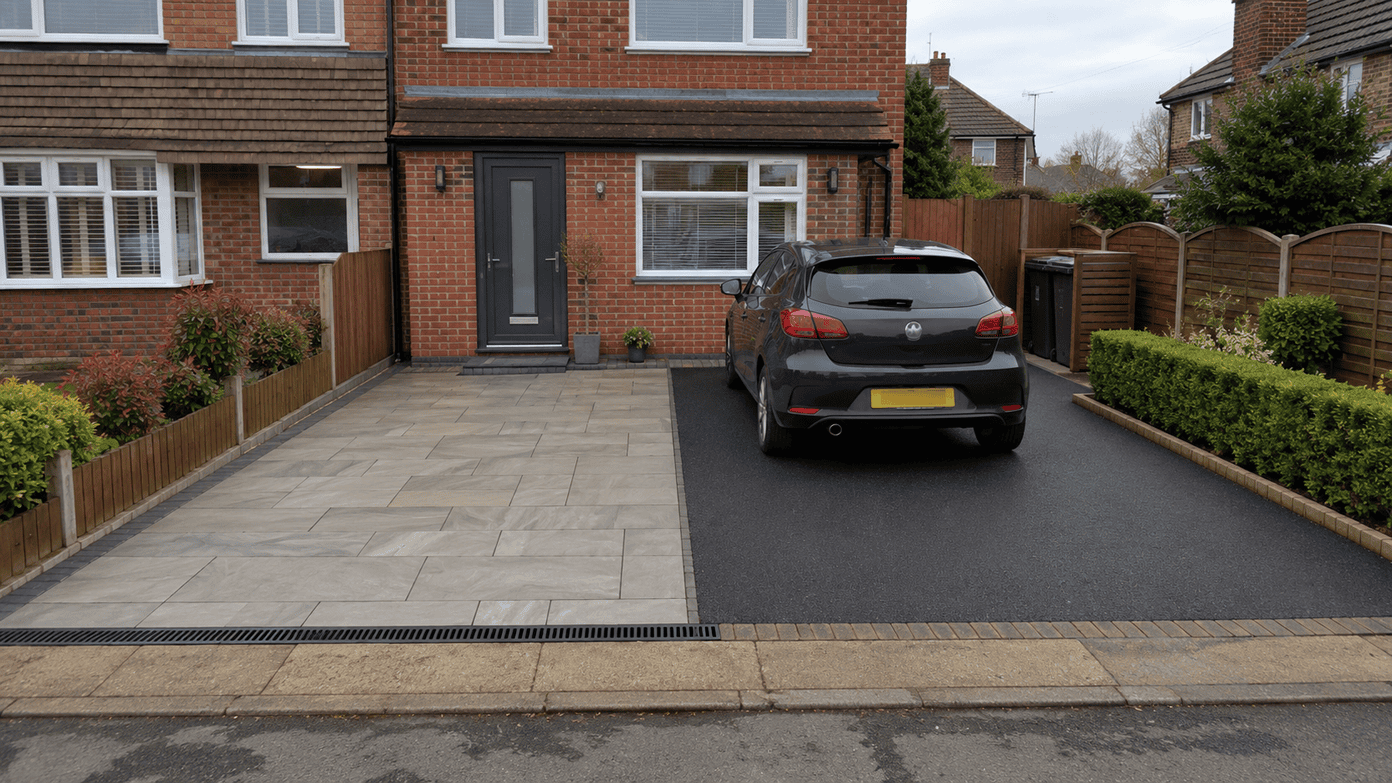


Two driveway quotes can describe the same grey paving and still cover very different jobs. One may include removing the old surface, rebuilding the base and sorting out drainage. Another may allow only for a new finish over what is already there.
To compare driveway quotes properly, check the measured area, groundwork, surface specification, drainage, waste removal and final payable price. Then look at the contractor’s experience, payment terms and aftercare.
The aim is to understand what you are buying before choosing who will do the work. Here is how to put competing quotations on an equal footing.
Start with the same brief
Give each contractor the same description of the project. Include the approximate size, your preferred finish, the vehicles using the driveway and any problems with puddles, sinking or access.
Explain whether you want to replace an existing drive or create parking from scratch. If you are still planning the layout, our guide to converting a front garden into a small driveway covers the wider design considerations.
You can use Get Driveway Prices to request quotations and compare driveway prices from independent local contractors, subject to availability. Give each business the same brief and ask for a written specification following its assessment of the site.
What should a driveway quote include?
A useful quotation identifies the work, materials and exclusions clearly enough for you to compare it with another offer.
| Item | What to ask the contractor to specify |
|---|---|
| Area and layout | Total square metres, boundaries and any paths or steps included |
| Removal and excavation | What will be lifted, how the ground will be prepared and what happens to the spoil |
| Sub-base | Proposed material, compacted depth and whether any existing base will be retained |
| Surface | Exact product or system, colour, thickness and laying pattern where relevant |
| Edging | Type, position and installation of edge restraints |
| Drainage | Proposed falls, water collection and where the water will go |
| Finishing work | Covers, thresholds, gate clearances and making good |
| Waste | Loading, transport and disposal arrangements |
| Price | Labour, materials, extras and the total payable, with VAT treatment stated |
| Programme and aftercare | Likely duration, payment stages, guarantee and maintenance guidance |
“New driveway supplied and fitted” leaves too much unanswered. Ask for the missing details before accepting it.
Groundwork deserves particular attention
Ask whether the contractor intends to rebuild the driveway or retain parts of the existing construction. If the base is being reused, what checks support that decision?
Avoid choosing a depth simply because it appears in a generic online guide. The proposed construction should suit the ground, surface system and expected vehicle use.
For hidden problems, agree how additional work will be handled. For example, the quote could explain how unexpected soft ground will be recorded, priced and approved before the contractor proceeds.
Compare named products
A description such as “premium blocks” does not tell you which paving you will receive. Ask for the manufacturer, range, colour and dimensions, together with confirmation that the product suits vehicle use.
Drainage claims also need detail. For example, Marshalls explains that its permeable paving works with a specially designed sub-base. Choosing a permeable block alone does not specify the complete construction.
Where contractors propose different finishes, ask for separate alternatives. Our comparison of asphalt and driveway slabs can help you frame those questions.
Ask where rainwater will go
“Drainage included” should lead to a clear explanation: where will water collect, and where will it discharge?
Ask the installer to show the proposed levels and drainage arrangement. A channel across the entrance is only one component; the quotation should also explain its connection or destination.
For house front gardens in England, the government’s guidance generally allows permeable surfacing, or a surface draining naturally to a lawn or border, without a planning application under these rules. Traditional impermeable surfacing covering more than 5m² generally needs permission if water is not directed to a permeable area. Read the government’s front-garden surfacing guidance.
Check property-specific restrictions with the planning authority. Do not assume the same rules apply throughout Wales, Scotland and Northern Ireland.
Keep dropped-kerb work separate
If the project involves new or altered access across a pavement, establish the highway authority’s requirements before committing to the driveway.
Ask whether the quotation includes any crossing work, applications and associated charges, or whether those are separate. The GOV.UK dropped-kerb service directs homeowners in England and Wales to their council’s information.
A finished parking space is of limited use if the access arrangements remain unresolved.
Compare the full price, including exclusions
A headline price is useful only when you know what it covers. The following example shows how excluded items can change the comparison.
Illustrative figures only: these are invented amounts for a hypothetical 40m² project, not researched market rates or quotations. Assume the same surface specification, that labour and materials are included in each applicable item, and that all figures include any applicable VAT.
| Cost item | Quote A | Quote B |
|---|---|---|
| Main driveway work | £4,000 | £4,800 |
| Drainage | £600 extra | Included |
| Waste removal | £350 extra | Included |
| Edging | £250 extra | Included |
| Comparable total | £5,200 | £4,800 |
| Total divided by 40m² | £130/m² | £120/m² |
Quote A starts £800 lower but finishes £400 higher once those items are included. Neither example includes dropped-kerb work or unexpected ground repairs.
Dividing by the area can help check comparable quotes, but it does not turn them into universal price-per-square-metre rates. A small, awkward site and a large, accessible driveway can have different cost structures.
Separate firm prices from allowances
Highlight wording such as “provisional”, “estimated” or “subject to ground conditions”. Ask what each allowance covers and what could change it.
Make sure VAT treatment is explicit. Also ask how long the quotation remains valid, when payments fall due and how changes to the agreed work will be authorised.
Why quotes vary between locations
Instead of applying a blanket regional percentage, ask contractors to explain the costs particular to your address.
A restricted urban site might need different delivery and loading arrangements from a property with generous access. A remote location may involve longer journeys or additional delivery charges. Local disposal facilities, parking arrangements and machinery access can also affect how a job is priced.
These are points to investigate, rather than reasons to assume that every London quotation should carry the same premium.
Rules need local attention too. Confirm planning requirements with the relevant authority and road-access requirements with the body responsible for the highway.
Check the business behind the quotation
A detailed specification matters, but so does knowing who will deliver it. Ask for:
- The business name, address and contact details.
- Evidence of current insurance relevant to the work.
- Recent examples of similar driveways and references you can contact.
- Confirmation of who will supervise the project and whether subcontractors will be involved.
- Written payment stages, guarantee terms and a process for reporting defects.
Ask who will remove the excavated material and where it will be taken. For work in England, the Environment Agency’s waste-carrier register lets you check registered businesses. Use the relevant regulator’s register elsewhere in the UK.
Read the guarantee carefully. Establish who provides it, what it covers, what maintenance is expected and how a claim would be handled.
How to compare driveway quotes in five steps
You will need your project brief, the written quotations and a simple comparison sheet.
1. Give every contractor the same brief
Share the intended area, preferred finish, access requirements and known problems. Ask each contractor to identify anything that needs further investigation.
2. Put the specifications side by side
Compare excavation, base construction, surface products, edging and drainage. Mark anything missing rather than assuming it is included.
3. Resolve exclusions and allowances
Request written clarification of waste removal, VAT, access work and possible extras. Ask for revised totals covering the same agreed scope.
4. Check the contractor and terms
Review references, insurance, waste arrangements, payment stages and guarantee wording. Clarify who will manage the installation.
5. Confirm the complete agreement
Keep the final specification, price, programme and agreed changes together. Make sure both sides are working from the same version before work starts.
Questions worth asking before you accept
Use the site visit to discuss how the work will affect everyday life. Will the front door remain accessible? Where will deliveries and waste containers go? How will adjoining paths and planting be protected?
Ask when you can walk and park on the finished driveway. The answer should reflect the specified materials and installation conditions, rather than a promise made before the system has been chosen.
Finally, agree what the handover will include: a joint inspection, correction of unfinished details, care instructions and any guarantee documents.
Frequently asked questions
How many driveway quotes should I get?
Aim for three written quotations where practical. Give each contractor the same brief so you can compare the scope, price and terms meaningfully.
Is the cheapest driveway quote always the best choice?
No. It may offer good value, but first check that it includes the same preparation, materials, drainage and finishing work as the other quotes. A higher price also needs to be justified.
Should driveway quotes include waste removal?
The quotation should clearly state whether waste removal is included, who will arrange it and whether disposal charges are covered. Do not assume that excavation automatically includes taking the spoil away.
Can I compare driveway quotes using price per square metre?
Yes, once the area and specification are comparable. Use the full payable total and remember that access, drainage and other fixed costs can make the rate misleading when comparing different properties.
What if a contractor finds unexpected problems?
Ask for an explanation, supporting photographs where useful and a written price for the proposed change. Agree how extra work will be approved before the project begins, rather than waiting for a problem to arise.
Choose the clearest complete offer
Before accepting a quotation, you should be able to explain what will be built, how drainage will work and what the final price includes.
If one proposal leaves those points unclear, send it back with questions. A few written clarifications now can make the difference between a straightforward driveway project and an argument over what was included.