

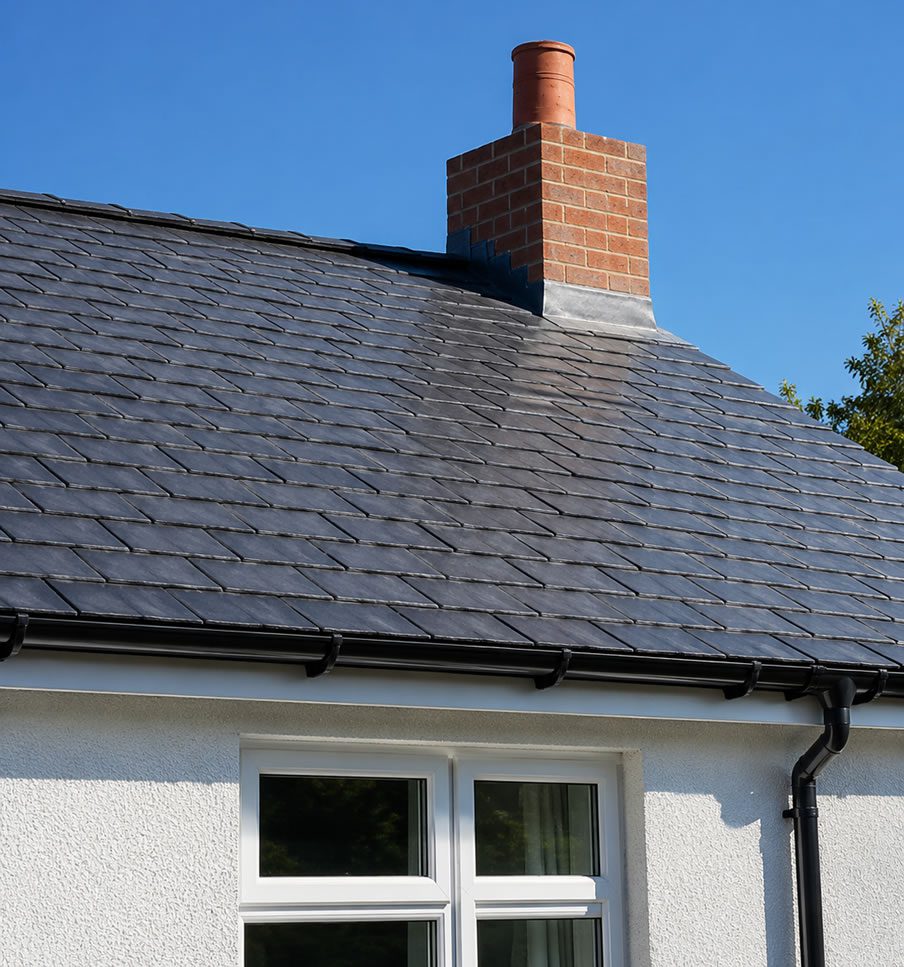
Composite slate and roof tiles are often chosen because they combine a traditional appearance with consistent sizing, relatively low weight and straightforward installation.
They may be made from fibre cement, recycled polymers, engineered resins, rubber compounds or a mixture of mineral and synthetic materials. Although these products are commonly described as low maintenance, they are not completely maintenance-free.
Over time, composite roof coverings can develop moss, surface staining, loose fixings, cracked corners or damage around ridges, valleys and roof windows. Some products also become brittle as they age, particularly where they have experienced heavy foot traffic, poor fixing or repeated temperature changes.
Regular inspections and gentle maintenance can help extend the life of the roof. However, the correct method depends on the exact product. A cleaning chemical or repair material that suits concrete tiles may damage a polymer-based slate or invalidate a manufacturer’s warranty.
This guide explains how to maintain composite slate and tile roofs, which problems to watch for and when local repair or larger replacement work may be needed.
What Is Composite Roofing?
Composite roofing is a broad term covering manufactured roof slates and tiles made from more than one material.
Products may contain:
- Fibre cement
- Recycled plastic
- Rubber
- Polymer resin
- Mineral fillers
- Glass fibres
- Recycled slate dust
- Pigments
- Protective surface coatings
Composite products are designed to imitate materials such as:
- Natural slate
- Clay plain tiles
- Stone slate
- Cedar shingles
- Traditional roof tiles
The exact composition and performance vary considerably between manufacturers.
Composite Slate vs Artificial Slate
The terms composite slate, artificial slate and synthetic slate often overlap.
| Term | Common Meaning |
|---|---|
| Composite slate | Manufactured slate using a mixture of materials |
| Artificial slate | General term for slate not made from natural stone |
| Synthetic slate | Often polymer, rubber or resin-based |
| Fibre-cement slate | Cement and reinforcing fibres formed into slate units |
| Recycled slate tile | Manufactured product containing recycled materials |
| Engineered slate | Marketing term for a manufactured slate-style product |
Before cleaning or repairing the roof, identify the manufacturer and product where possible.
Composite Roof Maintenance at a Glance
| Maintenance Task | Why It Matters |
| Ground-level inspection | Finds slipped, cracked or missing units |
| Gutter cleaning | Prevents overflow and roof-edge damage |
| Valley clearance | Maintains major drainage routes |
| Moss monitoring | Prevents blocked drainage and hidden faults |
| Fixing checks | Identifies wind-related movement |
| Ridge and verge inspection | Finds loose dry-fix components |
| Flashing inspection | Prevents leaks around junctions |
| Roof window checks | Finds flashing and seal faults |
| Loft inspection | Identifies leaks and condensation |
| Gentle cleaning | Removes dirt without damaging the surface |
| Spare material storage | Makes future matching easier |
| Storm inspection | Finds damage before water enters |
Are Composite Roofs Maintenance-Free?
No.
They may need less maintenance than some traditional materials, but they still form part of a complete roofing system containing:
- Battens
- Roofing underlay
- Nails or clips
- Ridge systems
- Verge components
- Flashing
- Valleys
- Gutters
- Roof windows
- Timber supports
Even if the composite tiles remain sound, other roof components may deteriorate.
Common Composite Slate and Tile Problems
| Problem | Possible Cause |
| Cracked corners | Foot traffic, impact or overtightened fixing |
| Slipped units | Loose, corroded or missing fixing |
| Surface fading | UV exposure and weathering |
| Moss growth | Shade, moisture and surface texture |
| Algae staining | Damp conditions and poor drying |
| Warping | Heat, age or product deterioration |
| Loose ridge tiles | Failed dry-fix system or mortar |
| Loose verge units | Poor fixing or wind uplift |
| Open joints | Movement or incorrect installation |
| Broken fixing holes | Overtightening or impact |
| Leaking roof window | Failed flashing or surrounding covering |
| Brittle tiles | Age, UV exposure or product breakdown |
| Water beneath covering | Poor overlap, broken units or damaged underlay |
| Condensation | Inadequate ventilation or insulation imbalance |
How Long Do Composite Slate and Tiles Last?
The potential lifespan depends on the product.
Broad expectations may include:
| Composite Product | Broad Potential Lifespan |
| Fibre-cement slate | 30–50 years |
| Polymer composite slate | 30–60 years |
| Recycled rubber slate | 30–50 years |
| Composite plain tiles | 30–60 years |
| Higher-grade engineered slate | 40–75 years |
These figures are general estimates rather than guarantees.
Performance depends on:
- Product quality
- Roof pitch
- Fixing method
- Wind exposure
- UV resistance
- Ventilation
- Installation quality
- Foot traffic
- Maintenance
- Availability of matching replacements
Identifying the Composite Roof Product
The first step in maintenance is identifying the material.
Useful clues include:
- Manufacturer markings
- Product codes
- Original invoices
- Installation guarantee
- Planning documents
- Spare tiles in the garage or loft
- Local builder specifications
- Appearance of broken edges
- Tile dimensions
- Fixing pattern
A roofer may need to lift one unit to inspect the back.
Why Product Identification Matters
The manufacturer may specify:
- Approved cleaning chemicals
- Maximum water pressure
- Repair methods
- Fixing type
- Replacement compatibility
- Minimum roof pitch
- Paint or coating restrictions
- Walking and access guidance
- Warranty conditions
Without identification, the safest approach is normally conservative and low impact.
Ground-Level Inspections
Inspect the roof from a safe position at least once or twice a year.
Look for:
- Missing units
- Uneven courses
- Lifted corners
- Cracks
- Gaps at ridges
- Loose verge caps
- Moss build-up
- Blocked gutters
- Broken flashing
- Debris after storms
- Sagging
- Colour changes
Binoculars or a professional drone inspection may help on higher roofs.
Loft Inspections
Check the loft after heavy rain and during cold weather.
Look for:
- Damp timbers
- Water staining
- Wet insulation
- Daylight through gaps
- Torn underlay
- Mould
- Condensation
- Rusted fixings
- Musty smells
- Sagging battens
A damp loft does not always mean the composite covering is leaking. Condensation and ventilation faults can create similar symptoms.
Cleaning Composite Slate and Tiles
Cleaning should be gentle.
Possible methods include:
- Manual moss removal
- Soft brushing
- Controlled low-pressure rinsing
- Manufacturer-approved biocide
- Gutter and valley clearance
- Local hand cleaning around roof windows
The safest method depends on the surface coating and material composition.
Can Composite Slate Be Pressure Washed?
Aggressive pressure washing is generally risky.
It can:
- Crack brittle units
- Damage coatings
- Force water beneath overlaps
- Lift lightweight tiles
- Damage fixings
- Expose fibres
- Mark the surface
- Invalidate warranties
- Flood the loft
Where rinsing is permitted, low pressure and the correct water direction are important.
Water should not be forced upwards beneath the roof covering.
Moss on Composite Roofing
Composite products can still grow moss.
Growth is more likely where the roof is:
- North facing
- Shaded
- Beneath trees
- Slow to dry
- Rough textured
- Near a chimney
- In a damp location
Moss may:
- Block gutters
- Fill valleys
- Hide cracked tiles
- Lift lightweight edges
- Retain moisture
- Fall onto paths
- Restrict roof drainage
Light surface growth does not automatically mean the roof needs cleaning.
When Should Moss Be Removed?
Removal may be useful where moss:
- Blocks water flow
- Fills gutters
- Covers flashing
- Lifts roof units
- Prevents inspection
- Collects around roof windows
- Falls into downpipes
- Creates a hazard below
Avoid unnecessary cleaning where the roof is old, brittle or otherwise functioning correctly.
Using Biocides
A suitable biocide may slow regrowth after loose moss is removed.
Before use, check:
- Manufacturer approval
- Material compatibility
- Nearby plants
- Rainwater harvesting
- Run-off control
- Application rate
- Weather conditions
- Required personal protection
Some strong chemicals can stain, soften or damage composite surfaces.
Roof Coatings and Paint
Composite roof tiles should not be painted or coated without manufacturer approval.
Possible problems include:
- Poor adhesion
- Trapped moisture
- Altered fire performance
- Uneven fading
- Blocked surface texture
- Reduced flexibility
- Warranty invalidation
- Difficulty matching future repairs
A coating should never be used to hide cracks, weak fixings or failed underlay.
Surface Fading
Fading can occur through sunlight and weather exposure.
A faded roof may still remain functional.
Replacement is not normally needed solely because:
- The colour is lighter
- Different slopes have weathered differently
- New replacement tiles look brighter
- Minor chalking is visible
Investigate further where fading is accompanied by:
- Cracking
- Powdering
- Surface breakdown
- Warping
- Delamination
- Brittleness
Chalking and Surface Powder
Some manufactured roof products develop a chalky surface as coatings weather.
A light residue may be cosmetic. Heavy breakdown may indicate deterioration.
A roofer or manufacturer should assess:
- Whether the surface remains stable
- Whether fibres are exposed
- Whether the unit has lost strength
- Whether cleaning will worsen the problem
- Whether the warranty still applies
Cracked Composite Slate
Cracks may be caused by:
- Foot traffic
- Falling branches
- Overtightened nails
- Poor support
- Hail
- Thermal movement
- Age-related brittleness
- Incorrect cutting
A cracked unit should normally be replaced rather than covered with general-purpose sealant.
Broken Corners
Corners can break where:
- Fixings sit too close to edges
- Tiles are overtightened
- Roofers walk directly on the covering
- Units were dropped during installation
- Battens are uneven
- Wind lifts unsupported edges
A small corner chip may not always create a leak, but it should be inspected.
Slipped Composite Slate
A slipped unit may indicate:
- Failed nail
- Missing clip
- Broken fixing hole
- Rotten batten
- Incorrect fixing position
- Wind uplift
- Poor installation
The repair should address the fixing point rather than simply pushing the unit back into place.
Composite Slate Repair Methods
Possible repair methods include:
- Replacing the damaged unit
- Refixing with manufacturer-approved nails
- Using suitable hooks or clips
- Replacing damaged battens
- Repairing underlay
- Renewing surrounding flashing
- Replacing a small local section
The correct method depends on the product and whether it is nailed, clipped, hooked or mechanically interlocked.
Can Composite Slate Be Repaired with a Hook?
Some artificial slate systems can be repaired using suitable slate hooks.
However, the hook must be:
- Compatible with the product
- Corrosion resistant
- Correctly sized
- Suitable for the roof exposure
- Installed without damaging nearby units
A hook repair should not be assumed suitable for every composite slate.
Composite Interlocking Tile Repairs
Composite roof tiles may use side locks similar to concrete or clay products.
The replacement must match:
- Profile
- Width
- Side lock
- Headlap
- Batten gauge
- Fixing position
- Thickness
A similar-looking tile from another system may not fit correctly.
Matching Replacement Composite Tiles
Matching can become difficult where the product is:
- Discontinued
- Faded
- No longer imported
- Replaced by a newer generation
- Made in an unusual colour
- Installed on a small development
Possible sources include:
- Original manufacturer
- Roofing merchants
- Reclamation suppliers
- Specialist roofing stockists
- Local contractors
- Spare materials left from installation
- Owners of similar nearby properties
Should Spare Composite Tiles Be Kept?
Yes.
Composite products may be difficult to match many years after installation.
Keep:
- Field tiles
- Ridge units
- Verge caps
- Vent tiles
- Half tiles
- Special fittings
Store them:
- Flat or as directed
- Dry
- Away from sunlight where appropriate
- Clearly labelled
- Safe from impact
- With the product code and manufacturer details
Replacing One Unit
A typical local repair may involve:
- Identifying the product.
- Arranging safe access.
- Lifting surrounding units.
- Removing the failed fixing.
- Inspecting the batten and underlay.
- Repairing hidden damage.
- Installing a compatible replacement.
- Fixing it correctly.
- Reinstating surrounding units.
- Checking the roof alignment.
When Several Tiles Need Replacement
A larger local repair may be needed where:
- Several units cracked during foot traffic
- Wind damaged one roof edge
- A branch struck the roof
- Solar installation caused breakages
- A roof window was replaced
- Battens failed beneath one area
- An earlier repair used incompatible products
Replacing one planned section may look and perform better than scattered patching.
Ridge Maintenance
Composite roofs may use:
- Matching ridge tiles
- Concrete or clay ridge units
- Dry ridge systems
- Mechanical ridge fixings
- Mortared ridge tiles
Check for:
- Loose ridge units
- Broken clips
- Missing screws
- Damaged ridge seals
- Cracked mortar
- Open end caps
- Movement after storms
Surface pointing should not be used to disguise loose ridge tiles.
Verge Maintenance
The roof verge may use:
- Dry verge caps
- Continuous trims
- Mortar
- Cloaked verge units
- Metal edging
Common faults include:
- Loose caps
- Broken plastic
- Missing fixings
- Rattling
- Exposed battens
- Gaps near the ridge
- Poor eaves closure
Loose verge components should be mechanically secured or replaced.
Dry-Fix System Maintenance
Dry ridge and dry verge systems are often described as maintenance-free. In reality, they should still be inspected.
Check:
- Screws
- Clips
- Seals
- Ridge unions
- Verge overlaps
- Eaves starters
- Ridge closures
- Supporting timber
- Cracked plastic components
Problems often come from poor original installation rather than the system itself.
Valley Maintenance
Composite slate roof and tiles may border valleys made from:
- Lead
- GRP
- Zinc
- Aluminium
- Proprietary valley troughs
- Concrete valley units
Valleys should remain clear of:
- Moss
- Leaves
- Broken tile pieces
- Mortar
- Bird nesting material
- Debris
Check the cut roof units beside the valley for cracks and loose fixings.
Flashing Maintenance
Inspect flashing around:
- Chimneys
- Roof windows
- Walls
- Parapets
- Dormers
- Valleys
- Pipes and vents
Leaks may come from the flashing rather than the composite covering.
Possible faults include:
- Split lead
- Loose step flashing
- Failed seal
- Incorrect laps
- Cracked mortar
- Poor membrane junctions
Roof Window Maintenance
Composite slate and tiles can be used around roof windows, but the flashing needs to match the roof covering thickness and profile.
Check:
- Side channels
- Top flashing
- Bottom apron
- Cut roof units
- Underlay collar
- Insulation
- Internal condensation
- Window seals
Do not apply sealant around the frame without identifying the real source of the leak.
Solar Panels on Composite Roofs
Solar installation can damage composite roofing if the installer walks directly on brittle units or uses unsuitable brackets.
Before installation:
- Check the roof condition
- Identify the product
- Keep spare tiles
- Confirm mounting compatibility
- Inspect battens
- Check the remaining roof lifespan
- Agree responsibility for breakages
After installation, inspect for:
- Cracks
- Raised tiles
- Damaged flashing
- Poor bracket clearance
- Broken underlay
- Loose units
Foot Traffic Damage
Composite slate can appear flexible or durable, but it may still crack under concentrated weight.
Damage often occurs during:
- Solar work
- Aerial installation
- Chimney repair
- Gutter cleaning
- Roof window fitting
- Pest-control work
- Moss removal
Suitable roof ladders, platforms or crawling boards should be used.
Gutter Maintenance
Blocked gutters can cause water to overflow back towards the roof edge.
Check:
- Leaves
- Moss
- Broken tile fragments
- Downpipe outlets
- Joints
- Falls
- Brackets
- Fascia condition
Composite tile fragments in the gutter may indicate cracking higher up.
Roofing Underlay
The composite covering is only the outer layer.
Underlay beneath it may become:
- Torn
- Brittle
- Sagging
- Short of the gutter
- Damaged by animals
- Punctured by poor fixings
- Worn around roof windows
A local underlay repair normally requires lifting the covering from above.
Battens and Fixings
Composite products rely on secure supporting battens and corrosion-resistant fixings.
Problems include:
- Rotten battens
- Split timber
- Rusted nails
- Loose clips
- Incorrect nail length
- Overtightened screws
- Missing fixings
- Poor wind-loading specification
Repeated slipping may indicate a problem with the supporting system rather than the tiles themselves.
Condensation Problems
A composite roof can remain watertight while the loft develops condensation.
Possible causes include:
- Blocked eaves ventilation
- Inadequate ridge ventilation
- Bathroom ducts ending in the loft
- Gaps around loft hatches
- Excess indoor humidity
- Insulation pushed into eaves
- Poor vapour control
Signs include:
- Water droplets beneath underlay
- Mould on several timbers
- Damp worse during cold weather
- Rusted nail tips
- Wet insulation without a rainfall pattern
Composite Roof Ventilation
Check that vents remain:
- Open
- Undamaged
- Free of moss
- Correctly connected
- Suitable for the roof design
Ventilation may be provided through:
- Eaves
- Ridge
- Tile vents
- Slate vents
- Counter-battened cavities
Adding random vents may create little benefit unless the airflow route is understood.
Storm Damage
After strong winds, check for:
- Lifted tiles
- Missing slate
- Loose verges
- Ridge movement
- Fallen branches
- Gaps around roof windows
- Debris in gutters
- Exposed underlay
Lightweight composite products can perform well in wind when correctly fixed. Poor fixing, however, can allow several units to lift together.
Hail and Impact Damage
Some composite products resist impact well, while others become brittle with age.
Hail or falling objects may cause:
- Cracks
- Punctures
- Surface chips
- Broken corners
- Hidden fractures
Close inspection may be needed after severe storms.
Fire and Heat Damage
Roofing products should not be exposed to uncontrolled heat.
Damage may occur from:
- Chimney fires
- Hot-work repairs
- Bonfires
- Solar equipment faults
- Incorrect flue clearances
Polymer-based products can behave differently from clay, concrete and natural slate when heated.
Repairs involving heat should follow the manufacturer’s guidance.
Chemical Damage
Avoid contact with:
- Solvents
- Strong acids
- Harsh bleach mixtures
- Bitumen where incompatible
- Paint thinners
- Unapproved adhesives
- Strong degreasers
Chemicals may soften, stain or weaken the product.
Composite Roof Coating Failure
Some manufactured products have factory-applied coatings.
Signs of failure may include:
- Peeling
- Flaking
- Uneven fading
- Exposed substrate
- Chalky residue
- Patchy colour
The installer or manufacturer should assess whether the issue is cosmetic or affects the product’s service life.
Repair or Replace?
| Roof Condition | Repair May Be Suitable | Replacement May Be Better |
| One cracked slate | Yes | No |
| Several storm-damaged tiles | Often | Depends on area |
| One loose ridge unit | Usually | No |
| Local underlay damage | Often | No |
| Widespread brittleness | Less likely | Usually |
| Product discontinued with many failures | Difficult | Often |
| Surface fading only | No repair needed | Usually unnecessary |
| Warping across several slopes | No | Often |
| Rotten battens throughout | No | Usually |
| Repeated slipping | Limited repair may fail | Consider re-roof |
| Widespread coating breakdown | Needs assessment | Possibly |
| Several incompatible repairs | Consolidation possible | Partial or full replacement |
When Local Repair Makes Sense
Repair is normally suitable where:
- The fault is isolated
- Matching replacements are available
- Surrounding units remain flexible and strong
- Battens and underlay are sound
- The roof has useful life remaining
- The fixing method can be restored properly
When Full Replacement May Be Needed
Replacement becomes more likely where:
- Units crack during normal access
- Large areas have warped
- Fixing holes are failing
- The product has become brittle
- Matching units cannot be found
- Battens have deteriorated
- Underlay has failed across the roof
- Multiple previous patches leak
- The roof is near the end of its expected life
Can Composite Slate Be Reused?
Some composite slate can be removed and reused carefully.
Reuse depends on:
- Age
- Flexibility
- Fixing-hole condition
- Product type
- Brittleness
- Manufacturer guidance
- Removal method
Natural slate is generally more suitable for repeated reuse than older fibre-cement or brittle polymer products.
Can Fibre-Cement Slate Contain Asbestos?
Modern fibre-cement slate should not contain asbestos.
However, older cement roofing products may contain asbestos, especially where installed before the UK ban.
Do not assume that an old grey manufactured slate is modern fibre cement.
Suspected material may need professional identification before it is drilled, cut or removed.
Composite Slate and Asbestos Lookalikes
Older asbestos cement and modern fibre-cement products can appear similar.
Warning signs may include:
- Older installation date
- Grey cement-like material
- Weathered fibrous edges
- No visible manufacturer marking
- Old outbuilding or garage roof
- Brittle sheet or slate format
Appearance alone cannot confirm asbestos content.
Safe Access
Composite roof maintenance often requires:
- Scaffolding
- Scaffold tower
- Roof ladders
- Edge protection
- Mobile access equipment
- Crawling boards
The correct method depends on:
- Roof height
- Pitch
- Material fragility
- Repair size
- Surrounding extensions
- Public access below
A contractor should not walk freely across an unfamiliar composite roof.
Can You Maintain a Composite Roof Yourself?
Homeowners can carry out limited ground-level tasks, such as:
- Visual checks
- Monitoring gutters
- Checking internal damp
- Keeping maintenance records
- Identifying spare tiles
- Checking loft ventilation from safe boarding
External work is usually better left to a roofer because the product may be fragile and difficult to match.
Typical Composite Roof Maintenance Costs
The following figures provide broad UK budgeting ranges.
| Service or Repair | Typical UK Cost |
| Basic visual roof inspection | £100–£250 |
| Drone roof survey | £150–£400 |
| Detailed condition report | £250–£700 |
| Gutter cleaning | £80–£250 |
| Valley clearance | £150–£400 |
| Replace one or two composite tiles | £180–£450 |
| Replace several artificial slates | £300–£900 |
| Local underlay repair | £400–£1,100 |
| Ridge or verge repair | £300–£1,200 |
| Roof window flashing repair | £400–£1,500 |
| Gentle moss removal | £600–£2,000 |
| Larger local roof repair | £800–£3,000 |
| Partial roof slope replacement | £2,500–£8,000 |
| Scaffolding | £500–£2,500 or more |
Rare or discontinued products may increase sourcing costs.
What Affects the Cost?
Product Availability
Discontinued composite tiles can take time to source.
Roof Height
Scaffolding may cost more than the replacement material.
Product Fragility
Brittle coverings take longer to access safely.
Extent of Damage
One cracked tile costs far less than a failed roof slope.
Hidden Damage
Underlay and batten repairs increase labour.
Roof Complexity
Dormers, valleys and roof windows add detailing.
Cleaning Method
Manual cleaning takes longer than aggressive washing but may be safer.
Waste Handling
Suspected asbestos-containing material requires specialist assessment and controls.
Composite Roof Servicing Process
A professional roof service may include:
- Reviewing the roof age and product.
- Inspecting from ground level.
- Checking the loft.
- Arranging safe access.
- Inspecting roof units and fixings.
- Checking ridges and verges.
- Clearing valleys.
- Cleaning gutters.
- Inspecting flashing.
- Checking roof windows.
- Assessing moss and surface condition.
- Completing agreed local repairs.
- Photographing defects and repairs.
- Providing future maintenance advice.
Maintenance Frequency
| Maintenance Task | Suggested Frequency |
| Ground-level inspection | Every six months |
| Check after storms | As required |
| Gutter cleaning | Once or twice a year |
| Valley inspection | Once a year |
| Loft inspection | Once or twice a year |
| Ridge and verge check | Every one to two years |
| Roof window check | Once a year |
| Professional roof inspection | Every two to five years |
| Cleaning | Only when needed |
Manufacturer Warranty Checks
A composite roof may have a material warranty.
Check:
- Warranty duration
- Registration requirements
- Installation conditions
- Approved fixings
- Cleaning restrictions
- Transferability
- Exclusions
- Colour-fade terms
- Labour cover
- Required inspections
A long material warranty may not cover installation faults or labour.
What Should a Maintenance Quote Include?
| Quote Item | Why It Matters |
| Product identification | Helps select correct methods |
| Roof areas inspected | Defines the service |
| Safe access | Important for cost and workmanship |
| Number of repairs included | Prevents confusion |
| Replacement material allowance | Clarifies sourcing |
| Cleaning method | Protects the roof surface |
| Gutter and valley clearance | Maintains drainage |
| Ridge and verge inspection | Finds loose dry-fix systems |
| Underlay and batten check | Identifies hidden damage |
| Roof window inspection | Common leak point |
| Photographs | Provides evidence |
| Waste removal | Covers moss and broken materials |
| Warranty considerations | Avoids invalidating cover |
| Extra work procedure | Controls further charges |
| Guarantee | Explains repair aftercare |
Questions to Ask a Roofer
- What type of composite slate or tile is installed?
- Can the manufacturer be identified?
- Is the product still available?
- Is the covering brittle?
- Are matching replacements available?
- Is the roof safe to access?
- What cleaning method do you recommend?
- Is the cleaning chemical manufacturer approved?
- Are the fixings secure?
- Is the underlay sound?
- Are the battens damaged?
- Do ridge or verge components need repair?
- Is the problem a leak or condensation?
- Does the work affect the product warranty?
- Could the old material contain asbestos?
- Does the price include scaffolding?
- Will I receive photographs?
- What guarantee applies?
Common Composite Roof Maintenance Mistakes
Assuming the Roof Is Maintenance-Free
Drainage, flashing and fixings still need checking.
Pressure Washing Without Identifying the Product
High pressure can damage coatings and brittle units.
Walking Directly on the Covering
Concentrated weight can crack artificial slate.
Using General-Purpose Sealant
Sealant may not bond to or move with the composite material.
Painting Without Approval
Coatings can invalidate warranties and trap moisture.
Using an Incompatible Replacement
Similar-looking products may have different dimensions and fixings.
Overtightening Fixings
This can crack corners and fixing holes.
Ignoring Surface Breakdown
Chalking, warping or brittleness may indicate ageing.
Disturbing Suspected Asbestos Material
Older manufactured roofing may need assessment.
Cleaning a Sound Roof Unnecessarily
Cosmetic cleaning can create avoidable damage.
Composite Roof Maintenance Checklist
| Task | Complete? |
| Identify roof product | |
| Check warranty documents | |
| Inspect from ground level | |
| Inspect after storms | |
| Check loft for damp | |
| Clear gutters | |
| Clear valleys | |
| Check cracked or slipped units | |
| Inspect ridge system | |
| Inspect verge system | |
| Check flashing | |
| Inspect roof windows | |
| Monitor moss | |
| Avoid pressure washing | |
| Check battens and underlay | |
| Store spare tiles | |
| Arrange periodic professional inspection |
Frequently Asked Questions
Are composite roof tiles maintenance-free?
No. They normally require less maintenance than some traditional coverings, but fixings, flashing, drainage, ridges and verges still need inspection.
How often should a composite roof be inspected?
A ground-level inspection twice a year and after severe storms is sensible. A professional check every two to five years may also be useful.
Can composite slate be pressure washed?
Aggressive pressure washing is generally not recommended because it can damage surfaces, lift tiles and force water beneath the roof covering.
Can moss grow on composite tiles?
Yes. Moss can grow on composite roofing, particularly on shaded or north-facing slopes.
Should moss be removed from composite slate?
Moss should be removed where it blocks gutters, valleys or drainage. Cleaning should use a gentle method suitable for the exact product.
Can composite slate crack?
Yes. It may crack through impact, foot traffic, overtightened fixings, ageing or poor support.
Can one composite slate be replaced?
In many cases, yes, provided a matching product remains available and the surrounding roof is sound.
What happens if matching composite tiles are discontinued?
A roofer may search specialist stock, use stored spares or recommend replacing a larger planned section with a compatible product.
Can artificial slate be repaired with a hook?
Some artificial slate systems accept suitable hook repairs, but the method should be compatible with the exact product.
Can composite roof tiles be painted?
They should not normally be painted without manufacturer approval because the coating may fail or invalidate the warranty.
Is surface fading a sign that the roof has failed?
Not necessarily. Colour fading may be cosmetic unless it is accompanied by cracking, warping, powdering or loss of strength.
Can composite slate be reused?
Some units can be reused carefully, although older brittle artificial slate may not tolerate removal as well as natural slate.
Can old artificial slate contain asbestos?
Some older cement-based roofing products contain asbestos. Suspected material should be identified before cutting, drilling or removal.
How much does composite roof maintenance cost?
A basic inspection may cost around £100 to £250. Larger servicing and repairs can cost £800 to £3,000 or more.
When should a composite roof be replaced?
Replacement may be needed where tiles have become brittle, warped or widely damaged, or where battens and underlay have failed across the roof.

