

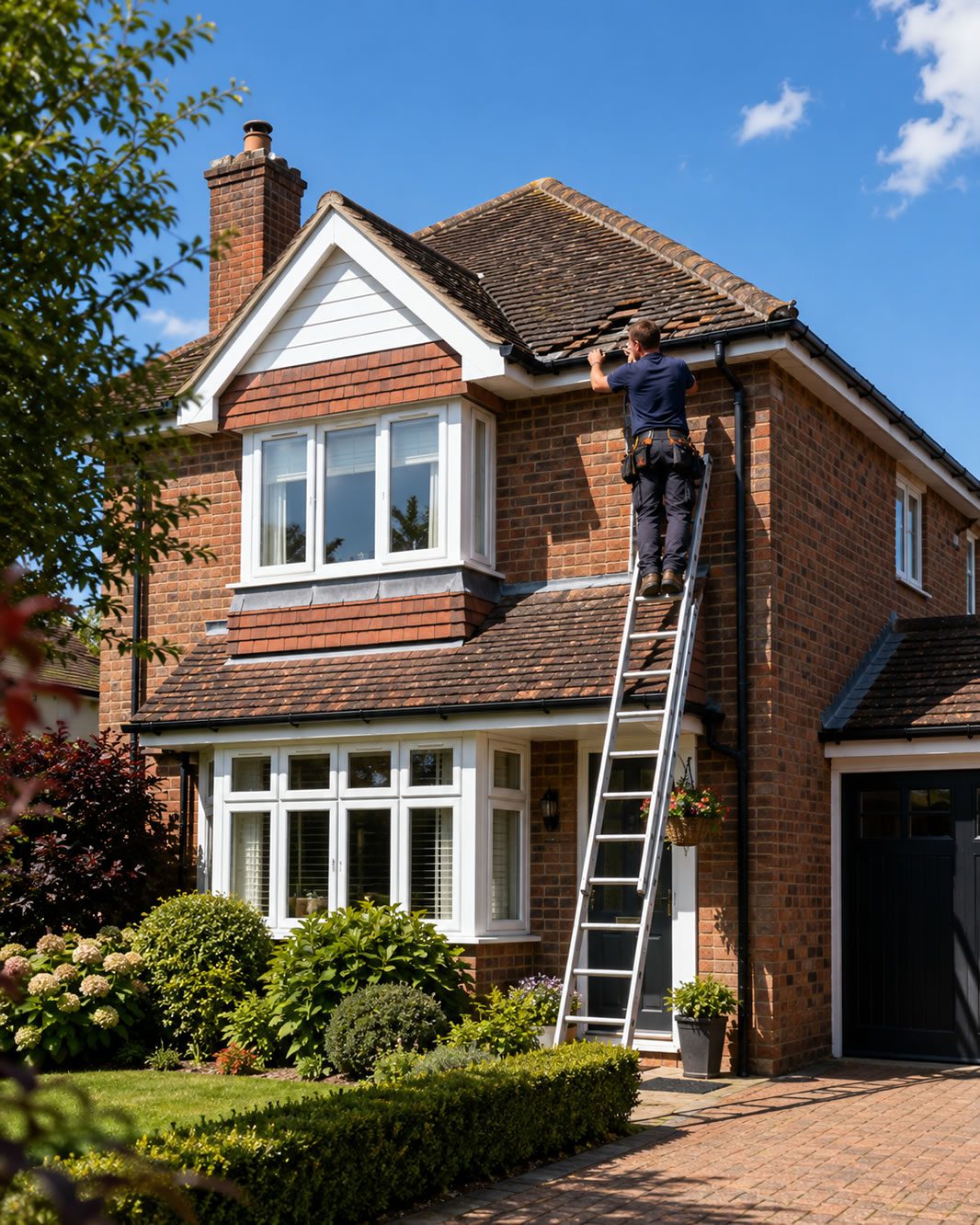
Soffits and fascias do not always receive much attention, yet they form an important part of a home’s roofline. Fascia boards support the lower edge of the roof and usually provide the fixing point for the guttering. Meanwhile, soffit boards close the underside of the roof overhang and can also provide ventilation to the roof space.
When these boards begin to rot, crack, warp or pull away, homeowners often face a choice between repairing the existing roofline and replacing it with a different material. However, there is no single perfect option for every property.
For most standard UK homes, uPVC provides the best combination of cost, low maintenance and resistance to wet weather. Nevertheless, timber may suit a traditional or listed property better, while aluminium and fibre cement can provide a more premium finish.
This guide compares the main materials available for soffits and fascias in the UK, including uPVC, timber, aluminium, fibre cement and composite products. It also explains the advantages, disadvantages, likely costs and situations where each material makes the most sense.
What are fascias and soffits?
The fascia is the vertical board that runs along the lower edge of the roof. It sits behind the guttering and helps create a neat finish between the roof covering and the outside wall.
The soffit sits beneath the fascia and covers the underside of the roof overhang. Depending on the design of the roof, the soffit may include ventilation slots or grilles that allow air to enter the roof space.
Together, fascias and soffits help:
- support and secure the guttering
- protect roof timbers from weather exposure
- close gaps around the eaves
- discourage birds and pests from entering
- support roof-space ventilation
- create a tidy roofline around the property
Therefore, choosing the right material involves more than appearance alone.
What is the best fascia and soffit material?
For most homeowners, uPVC is the best all-round material. It costs less than many premium alternatives, needs very little maintenance and does not rot in the same way as timber.
However, the best option depends on the property.
| Property or Priority | Best Material to Consider |
|---|---|
| Standard modern house | uPVC |
| Lowest maintenance | uPVC or aluminium |
| Period property | Timber |
| Premium contemporary finish | Aluminium |
| Traditional appearance with less maintenance | Wood-effect uPVC or fibre cement |
| Greater resistance to impact and heat | Fibre cement |
| Lowest initial cost | uPVC |
| Easy repainting and colour changes | Timber |
| Long-term metal roofline system | Aluminium |
uPVC fascias and soffits
uPVC is the most common replacement roofline material in the UK. It has largely replaced painted timber on many modern and renovated homes because it resists moisture and requires little routine maintenance.
Advantages of uPVC
uPVC offers several practical benefits:
- it does not rot like untreated timber
- it needs no regular painting
- it comes in many colours and finishes
- installers can fit it relatively quickly
- replacement boards and trims are widely available
- it usually costs less than aluminium or fibre cement
- homeowners can clean it with mild detergent and water
White remains the most common choice. However, black, grey, brown and woodgrain finishes have also become popular.
Disadvantages of uPVC
Despite its advantages, uPVC has some limitations:
- cheaper products may discolour over time
- dark colours can expand more in direct sunlight
- poor fitting may lead to warping or open joints
- it may look less authentic on a period property
- matching an older colour can become difficult
- damaged sections usually need replacement rather than refinishing
The quality of the installation matters just as much as the board itself. Roofers must leave appropriate expansion gaps, use the correct fixings and support the guttering properly.
When is uPVC the best choice?
uPVC often makes the most sense when:
- you want a practical, low-maintenance roofline
- the property already has uPVC windows and guttering
- you want to keep costs under control
- you do not want to repaint timber regularly
- the house has a modern or conventional appearance
For the majority of standard semi-detached, terraced and detached UK homes, uPVC provides the strongest balance of price and performance.
Timber fascias and soffits
Timber is the traditional roofline material. Many older properties originally had softwood fascia and soffit boards, while premium projects may use hardwood or treated engineered timber.
Advantages of timber
Timber can provide:
- a natural and traditional appearance
- a suitable finish for period properties
- the ability to repaint or change colour
- straightforward local repairs
- strong compatibility with traditional roof details
- a finish that may satisfy conservation requirements
A skilled joiner can also shape timber to match decorative bargeboards, mouldings and other original features.
Disadvantages of timber
The main drawback is maintenance. Timber needs protection from moisture, and exposed roofline boards face rain, frost, sun and overflowing gutters.
Potential problems include:
- peeling or cracked paint
- rot around gutter brackets and joints
- warping or splitting
- insect attack in neglected boards
- regular sanding and repainting
- higher lifetime maintenance costs
Even treated timber can deteriorate if water sits against it for long periods.
When is timber the best choice?
Timber may prove the best option when:
- the property is listed
- the home lies within a conservation area
- original roofline details need to be retained
- you want an authentic period finish
- decorative shaping or moulding matters
- you are willing to maintain and repaint the boards
For a Victorian, Edwardian or heritage property, timber can look much more appropriate than standard white plastic.
Aluminium fascias and soffits
Aluminium provides a durable and modern roofline finish. Manufacturers usually apply a powder-coated surface, which gives the metal its colour and protects it from weathering.
Advantages of aluminium
Aluminium offers:
- a clean, contemporary appearance
- strong resistance to rot
- low routine maintenance
- good dimensional stability
- a wide range of powder-coated colours
- suitability for modern architecture
- compatibility with metal guttering systems
Unlike timber, aluminium does not need regular repainting. In addition, it tends to feel more substantial than basic plastic roofline products.
Disadvantages of aluminium
The main drawbacks include:
- a higher initial price than uPVC
- fewer installers in some areas
- dents can prove difficult to repair
- poor cutting or fixing may damage the coating
- it may look too modern on some older houses
- replacement colours may vary slightly between batches
Installers must also detail joints carefully because different metals can react when they remain in contact in damp conditions.
When is aluminium the best choice?
Aluminium may suit:
- modern new-build homes
- architect-designed extensions
- properties with aluminium guttering
- homeowners who want a premium low-maintenance finish
- exposed homes where a robust roofline matters
- projects using dark grey or black external finishes
Although aluminium costs more upfront, it can make sense where appearance and durability take priority over the lowest initial price.
Fibre cement fascias and soffits
Manufacturers create fibre cement boards from cement reinforced with fibres. These products can provide a solid, weather-resistant alternative to timber and plastic.
Fibre cement already appears widely in cladding and roofing products. Some manufacturers also offer boards suitable for fascia, soffit and other external trim applications.
Advantages of fibre cement
Fibre cement can offer:
- strong resistance to moisture
- resistance to rot
- better dimensional stability than timber
- a solid and substantial finish
- good resistance to fire compared with plastic or timber products
- painted or factory-finished colour options
- suitability for traditional and contemporary designs
It can also provide a timber-style appearance without the same level of maintenance as real wood.
Disadvantages of fibre cement
However, it also has drawbacks:
- it weighs more than uPVC
- cutting requires suitable tools and dust controls
- installation may take longer
- material costs usually exceed basic uPVC
- fewer contractors specialise in fitting it
- edges and fixings need careful detailing
Because the boards are heavier, the installer must check that the supporting roofline remains sound.
When is fibre cement the best choice?
Fibre cement may work well when:
- you want a robust premium product
- the design uses fibre cement cladding elsewhere
- you want a painted or timber-style finish
- resistance to moisture and fire matters
- you want an alternative to plastic
- the supporting structure can carry the extra weight
It can provide a useful middle ground between traditional timber and premium metal systems.
Composite fascias and soffits
The term “composite” covers several different products. Some boards combine wood fibres and plastic, while others use resin, minerals or multiple bonded layers.
Therefore, homeowners should check the exact product rather than relying on the composite label alone.
Advantages of composite boards
Depending on the product, composite roofline boards may offer:
- reduced maintenance
- resistance to moisture
- wood-effect finishes
- a more solid feel than basic uPVC
- a broad range of colours
- improved dimensional stability
Disadvantages of composite boards
Possible disadvantages include:
- higher cost
- limited availability
- difficulty matching boards later
- product quality varying between brands
- unclear long-term performance for less established products
- special fixing requirements
Composite products can work well, but homeowners should ask for the manufacturer, specification and warranty before agreeing to installation.
Material comparison at a glance
| Material | Cost Level | Maintenance | Appearance | Main Strength | Main Weakness |
| uPVC | Low to medium | Very low | Modern and conventional | Best all-round value | Can look less authentic |
| Timber | Medium | High | Traditional and natural | Best for period homes | Needs regular painting |
| Aluminium | High | Very low | Premium and contemporary | Durable modern finish | Higher installation cost |
| Fibre cement | Medium to high | Low | Painted or timber-style | Solid and weather resistant | Heavy and more specialist |
| Composite | Medium to high | Low | Varies by product | Choice of finishes | Quality varies between brands |
What are the best materials for UK weather?
UK rooflines must cope with frequent rain, frost, wind, summer heat and occasional snow. Coastal areas also expose metalwork and fixings to salt-laden air.
Best for wet weather
uPVC, aluminium and fibre cement all resist moisture well. Timber can also perform well, but only when installers prepare it correctly and homeowners keep up with painting and maintenance.
Best for coastal locations
Powder-coated aluminium, good-quality uPVC and fibre cement can all suit coastal homes. However, installers should use suitable corrosion-resistant fixings.
Best for exposed rural homes
A rigid, well-supported uPVC, aluminium or fibre cement system can work well. Nevertheless, the installation and gutter support matter because wind loading and heavy rainfall can place extra strain on the roofline.
Best for very sunny elevations
Light-coloured uPVC generally handles heat better than very dark plastic boards. Aluminium and fibre cement also provide good options where homeowners want dark colours on a strongly sunlit elevation.
Ventilated or solid soffits?
Material choice is only part of the decision. The roof may also need ventilation at the eaves.
Ventilated soffits contain slots or holes that allow air to enter the roof space. Alternatively, an installer may use separate over-fascia or circular vents.
Correct ventilation can help control condensation in a cold roof space. However, the required arrangement depends on the roof construction.
An installer should check:
- whether the existing roof uses eaves ventilation
- whether insulation blocks the airflow
- whether over-fascia vents already exist
- whether extractor fans incorrectly discharge into the loft
- whether ventilation needs upgrading during replacement
Homeowners should not replace ventilated soffits with fully solid boards unless another suitable ventilation route remains available.
Full replacement or capping over timber?
Some companies offer to cap existing timber boards with thin uPVC rather than removing them completely.
Capping can cost less because it reduces labour and waste. However, it only makes sense if the timber beneath remains sound.
Possible advantages of capping
- lower initial cost
- less disruption
- faster installation
- reduced waste
Possible disadvantages of capping
- it may conceal rot
- moisture can remain trapped
- gutter fixings may still rely on old timber
- the finish may not last if the boards underneath continue to fail
- future repairs can become more complicated
Full replacement usually provides the better long-term option when the original timber has softened, split or rotted. The installer can remove the damaged boards, inspect the rafter ends and fix the new fascia to sound timber.
Typical fascia and soffit replacement costs
Prices depend on the material, property size, roof shape, access and whether the guttering also needs replacement.
| Type of Property or Work | Typical Guide Price |
| Small terraced property | £1,500 to £3,000+ |
| Small or average semi-detached house | £2,500 to £4,500+ |
| Detached house | £3,500 to £7,000+ |
| Large or complex detached property | £5,000 to £9,000+ |
| Guttering replacement at the same time | Usually additional |
| Premium aluminium or fibre cement system | Higher than standard uPVC |
| Scaffolding and complex access | May add substantially to the quote |
These figures offer broad guidance rather than a fixed price list. A simple bungalow may cost less, while dormers, conservatories, gable ends and difficult scaffolding can push the price higher.
What affects fascia and soffit replacement prices?
Material choice
uPVC normally costs the least. Timber usually requires more finishing work, while aluminium and fibre cement tend to sit at the premium end.
Property size
Longer rooflines require more boards, fixings and labour.
Roof complexity
Gable ends, dormers, porches and decorative sections add cutting and jointing work.
Scaffolding
Safe access can form a significant part of the quote, particularly on tall or awkward houses.
Condition of the roof timbers
Rotten rafter ends or damaged roof edges need repair before the installer fits new fascias.
Guttering
Many homeowners replace gutters and downpipes at the same time. Although this increases the total, combining the work can reduce repeated access costs.
Ventilation
The installer may need ventilated soffit boards, over-fascia vents or other upgrades to maintain roof-space airflow.
Colour and finish
Standard white uPVC usually costs less than woodgrain, grey or specialist coloured finishes.
Should you replace the guttering at the same time?
Replacing the guttering can make sense when:
- the gutters are old or brittle
- joints leak regularly
- the existing colour will not match
- brackets need refixing to new fascias
- scaffold or access equipment is already in place
- downpipes also need work
However, sound guttering may not need replacement simply because the fascia and soffit boards are being renewed.
Ask the installer to provide separate prices for:
- fascias and soffits only
- fascias, soffits and guttering
- any timber or roof-edge repairs
This makes it easier to judge the value of each option.
Which material lasts the longest?
Lifespan depends heavily on product quality, exposure and installation.
| Material | Broad Expected Service Life |
| Good-quality uPVC | Often 20 to 40+ years |
| Maintained timber | Often 20 to 40+ years |
| Aluminium | Often 30 to 50+ years |
| Fibre cement | Often 30 to 50+ years |
| Composite | Varies considerably by product |
These ranges are only general indications. A poor installation can shorten the life of any material, while regular maintenance can help timber last for decades.
Which material needs the least maintenance?
Aluminium and uPVC usually need the least routine care.
Homeowners may only need to:
- wash away dirt
- clear gutters
- check joints
- inspect fixings
- remove algae or staining
Fibre cement also needs relatively little maintenance. Timber, in contrast, usually needs periodic inspection, preparation and repainting.
Which material looks best?
Appearance depends on the property.
For a modern house, grey or black aluminium may produce the cleanest finish. Meanwhile, white or woodgrain uPVC often suits conventional suburban homes.
On a period property, painted timber usually provides the most authentic appearance. Fibre cement may also work where the homeowner wants a premium painted finish with less upkeep.
The best-looking option is usually the one that matches:
- the age of the property
- the window frames
- the guttering
- the roof covering
- nearby homes
- any planning or conservation requirements
Common mistakes to avoid
Choosing on price alone
A cheap system can become expensive if the installer caps over rot or uses boards that are too thin for the application.
Ignoring ventilation
Replacing ventilated soffits with solid boards can reduce airflow into the roof space.
Fitting new boards over damaged timber
The installer should remove or repair rotten supporting timber before fixing the new roofline.
Using unsuitable fixings
Roofline fixings need to resist corrosion and allow for movement in the material.
Forgetting the gutter fall
The installer must refit the gutters with the correct fall towards the outlets.
Failing to compare complete quotes
One quotation may include scaffolding, waste and new guttering, while another may only cover the boards.
How to compare fascia and soffit quotes
Before choosing a contractor, ask:
- Will you remove the existing boards completely?
- What brand and thickness of board will you use?
- Is the fascia a full replacement board or a thin capping board?
- How will you maintain roof ventilation?
- Will you inspect the rafter ends?
- Are scaffolding and waste removal included?
- Does the quote include gutters and downpipes?
- What colour and finish have you specified?
- What product and workmanship guarantees apply?
- Does the price include VAT?
A detailed quote helps you compare materials and workmanship rather than just headline prices.
Which fascia and soffit material should you choose?
For most UK homes, the following recommendations provide a useful starting point:
- Choose uPVC for the best overall balance of affordability, low maintenance and availability.
- Choose timber for listed, period or traditional properties where appearance matters most.
- Choose aluminium for a premium contemporary finish and minimal maintenance.
- Choose fibre cement for a solid, durable alternative to timber and plastic.
- Consider composite boards carefully, checking the brand, warranty and fixing specification.
The material matters, but installation quality matters just as much. Well-fitted mid-range uPVC can outperform an expensive product installed poorly.
Get fascia and soffit replacement quotes
If your roofline boards are cracked, rotten, warped or pulling away, compare quotes before deciding which material to use.
A local roofline specialist can inspect the existing boards, check the rafter ends, review ventilation and provide prices for uPVC, timber or premium alternatives.
Use the quotation form on this page to compare fascia and soffit replacement quotes from local specialists.
Frequently asked questions
What is the best material for fascias and soffits?
For most UK homes, uPVC provides the best balance of price, low maintenance and weather resistance. However, timber may suit period properties better, while aluminium and fibre cement offer premium alternatives.
Is uPVC better than timber for fascias?
uPVC needs less maintenance and will not rot in the same way as timber. However, timber often looks more authentic on traditional or listed properties and can be repaired or repainted.
Are aluminium fascias worth the extra cost?
Aluminium may justify the extra cost where homeowners want a durable, low-maintenance and contemporary finish. However, standard uPVC usually provides better value for a conventional house.
Can installers cover old timber fascias with uPVC?
They can cap sound timber with thin uPVC boards. However, they should not cover rotten or badly damaged timber because the underlying problem may continue.
Do soffits need ventilation?
Many cold roof spaces need ventilation at the eaves. Therefore, installers may use vented soffit boards, over-fascia vents or separate ventilation grilles.
How long do uPVC fascias and soffits last?
Good-quality uPVC roofline products can often last several decades when installers fit them correctly and homeowners keep the gutters clear.
Is fibre cement better than uPVC?
Fibre cement feels more solid and offers strong resistance to moisture and fire. However, it costs more, weighs more and needs more specialist installation than uPVC.
Should I replace gutters with the fascias and soffits?
It often makes sense when the gutters are old, leaking or no longer match. However, installers can usually reuse sound guttering if it remains suitable.
How much does fascia and soffit replacement cost?
A typical UK replacement may cost from around £1,500 for a smaller, straightforward property to £7,000 or more for a large or complex detached home. Material, scaffolding and guttering all affect the total.
Do I need planning permission to replace fascias and soffits?
Most like-for-like replacements do not need planning permission. However, listed buildings, conservation areas and significant changes to appearance may require additional checks.

