

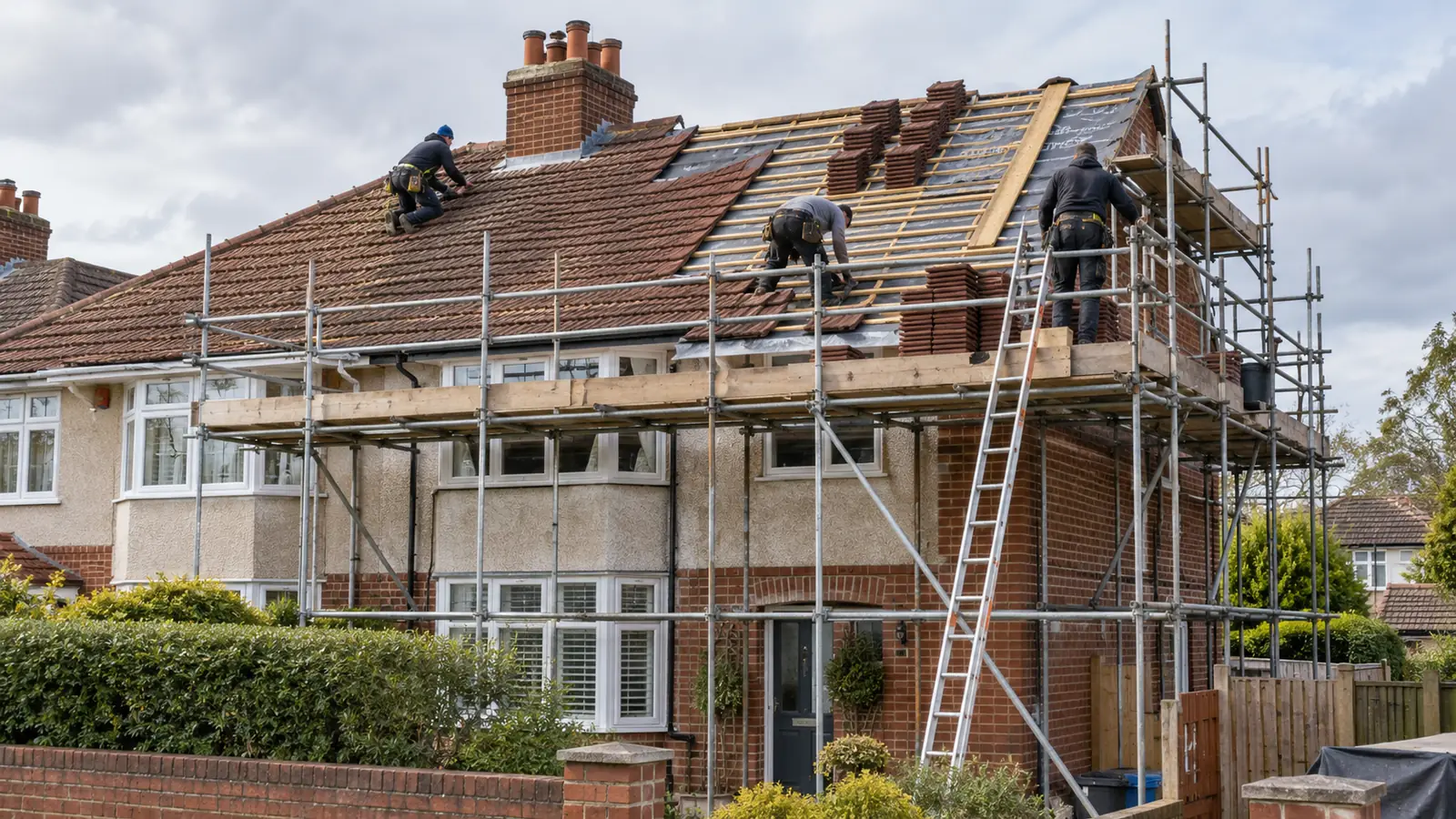
A new roof quote should tell you what will be removed, what will be fitted and how the roofer will deal with anything hidden beneath the old covering. Ask two or three contractors to price the same scope, then compare the details as well as the total. A low price is difficult to judge if it leaves out scaffolding, disposal, leadwork or timber repairs.
As a broad UK guide, Cost Calculator puts a typical full re-roof at about £9,000, with most jobs between £4,600 and £18,000 including 20% VAT. Its figures are indicative, reviewed in September 2026, and depend on the property, access and specification. Use the new roof cost calculator to understand the possible range before you request a site-specific written quotation.
Start with the same brief for each roofer
Describe the property, roof type and problem you are trying to solve. Say whether you want a like-for-like replacement or are considering a different tile or slate. Share any known leaks, previous repairs, chimney issues, loft damp or planned insulation work. Photographs taken safely from ground level can help, but a roofer should inspect the roof and access before committing to a detailed price.
Make clear whether the quote should cover the whole roof or particular slopes, and whether gutters, fascias, soffits, chimney work or roof windows are part of the job. Optional work can be priced separately. This avoids comparing one contractor’s full replacement with another’s limited repair.
What should a new roof quote include?
| Part of the work | What to look for in the written quote |
|---|---|
| Access and protection | Scaffold or other access, how long it remains, pavement or neighbour access arrangements where relevant, and protection for the property below. |
| Strip-out and waste | Removal of the existing covering, skips or other waste collection, disposal charges and any exclusions for unusual materials. |
| Underlay and battens | Whether both are new, their specification and how ventilation and eaves details will be handled. |
| Tiles or slates | Product, manufacturer, profile or type, colour, quantity and whether matching ridge and hip components are included. |
| Junctions and finishes | Valleys, flashings, chimney abutments, verges, ridge, hips and rainwater details, with any leadwork clearly described. |
| Timber and hidden defects | What is included, what remains provisional, the rate for extra repairs and how approval will be obtained before they are done. |
| Completion and terms | Estimated programme, VAT, payment stages, final clean-up, guarantees and any building control responsibilities. |
Ask for the actual covering to be identified, not just “new tiles”. A change from concrete tiles to slate, for example, can affect price and roof loading. If a quote says “replace lead as required”, ask which flashings have been allowed for and how additional work would be priced.
Understand what can change after the roof is opened
Some defects are invisible until the existing covering comes off. Battens may be rotten, underlay may have failed, and timber around a long-standing leak may need repair. A responsible quotation can contain a provisional allowance or a stated labour and materials rate for this work. It should also explain how the contractor will document the problem and seek your agreement before adding to the bill.
Access is another major variable. A straightforward semi-detached house with clear side access is a different job from a tall terrace where materials must pass through the house or scaffolding needs to span a pavement. Roof shape matters too: valleys, dormers, chimneys and hips create more cutting and detailing than a simple gable roof of similar area. Ask contractors to explain any difference between their proposed methods rather than assuming the cheapest specification is equivalent.
Check permissions and who will handle them
For a house in England, like-for-like re-roofing that does not materially change its appearance will usually not need planning permission. Restrictions may apply to listed buildings, conservation areas and properties without the relevant permitted development rights. The Planning Portal roof guidance explains the English position; check with your local planning authority when your property or proposal is unusual. Rules elsewhere in the UK can differ.
Planning permission and Building Regulations are separate questions. The Planning Portal’s guidance on work to an existing roof identifies circumstances in England where approval may be needed, including extensive re-covering, structural alterations or a significantly heavier covering. Ask each roofer whether building control notification or a competent person route applies, who will arrange it and what completion paperwork you will receive. Seek advice from your local building control body if the answer is unclear.
Compare the contractor as well as the price
Check business details, relevant insurance and examples of comparable roofs. Ask who will actually carry out the work, who supervises it and whether any subcontractors are involved. The NFRC homeowners’ guide recommends clarifying any points in a roofing quotation that you do not understand before appointing a contractor.
Ask what the workmanship guarantee covers, how long it lasts and whether it is insurance-backed. A manufacturer’s product warranty and a contractor’s workmanship promise are different things. Get the scope, timescale, payment stages and process for variations in writing. If old roofing materials will be taken away, check who carries the waste. GOV.UK explains how householders can check a registered waste carrier and links to the relevant registers across the UK.
How to compare roof quotes step by step
Prepare from the ground or inside the property; do not climb onto the roof to gather information. You need your property details, any existing survey or repair records, safe photographs and a copy of each written quotation.
- Give contractors the same brief. Describe the roof, known faults, desired covering and any related work you want included or priced separately.
- Check the scope line by line. Compare access, strip-out, underlay, battens, covering, junctions, disposal and final making good.
- Mark provisional items. Ask what may change after strip-out, the rates that apply and how extra work must be authorised.
- Check compliance and terms. Confirm who handles any necessary approval, plus insurance, guarantees, VAT, payment stages and expected timing.
- Request comparable revisions. If one roofer has omitted an item or proposed a different system, ask for a revised written option before deciding.
Keep the final accepted quotation and any agreed changes together. If an unexpected problem is found, request photographs and a written price for the remedy before extra work proceeds, where it is safe and practical to pause.
Frequently asked questions
How many new roof quotes should I get?
Two or three detailed written quotes usually give you a useful basis for comparison. More prices will not help if each contractor has assumed a different scope.
Is scaffolding normally included in a roof replacement quote?
It should be stated clearly, whether included or excluded. Ask what access is proposed, who arranges it and whether the price covers its full hire period.
Can a roofer give a fixed price before removing the old roof?
The visible work can be priced, but hidden timber or deck repairs may remain provisional. Ask for the method and rates for dealing with discoveries rather than an unsupported promise that there will be no extras.
Should I choose the cheapest re-roofing quote?
Only after checking that materials, access, waste, detailed work, guarantees and VAT are comparable. A higher quote may include work another contractor has omitted; a lower quote may still be sound when its scope is genuinely equivalent.
Get a written scope you can trust
The best quote is one you can understand and compare. Be specific about the roof you want, ask what is included and agree how hidden repairs will be handled. When your brief is ready, you can request roofing quotes through AllPros and compare the proposals you receive without an obligation to accept one.

