

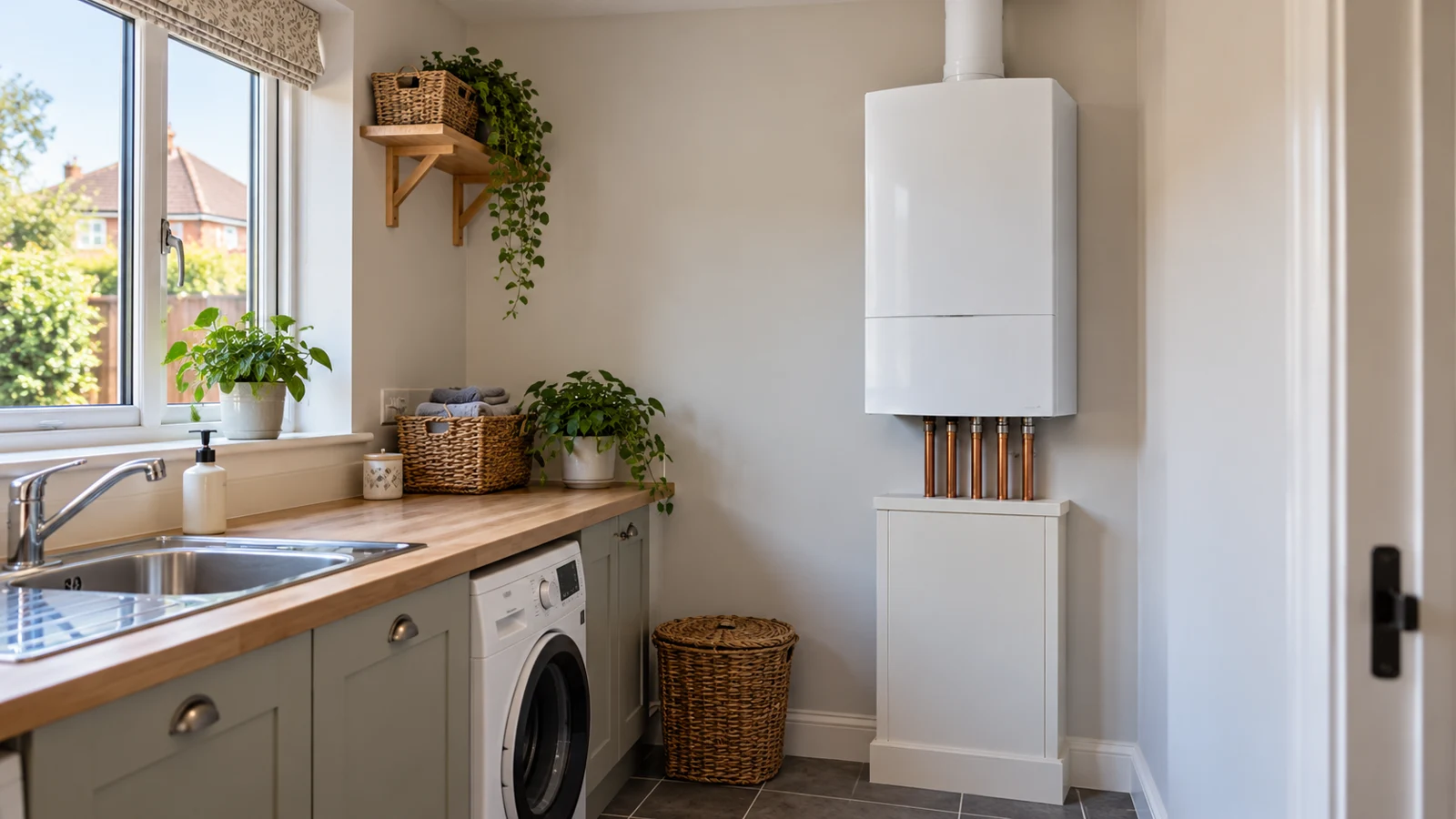
Keeping a replacement boiler in its existing position can limit pipework changes and disruption, provided the location suits the new appliance. Moving it may be worthwhile during a kitchen renovation or when access is poor, but the new position needs a proper survey. Compare two written scopes before deciding: the boiler you need, the connections it needs and the work required to leave each location finished.
AI-generated illustration of a boiler in a British utility room; not an actual AllPros installation.
When keeping the boiler in the same position makes sense
If the current position offers practical servicing access and fits your plans for the room, there may be little benefit in moving it. A replacement can still involve a new flue, changes to controls and alterations to connecting pipes. “Same position” describes the location; it does not mean every existing connection can stay.
Ask the engineer to check the proposed appliance against the available space, including the clearances in its installation instructions. A boiler that fits within the visible cupboard opening may need additional room for servicing or component removal. Tell the surveyor if the surrounding cupboards will change.
Retaining the position also avoids creating a second area of disturbance. However, do not keep an awkward location simply because it is familiar. If routine access requires moving appliances, removing fixed shelving or reaching over a worktop, discuss whether a different arrangement would be more practical.
When moving a replacement boiler could be worthwhile
A move can free a kitchen wall for storage, take the appliance out of a bedroom or align it with a wider refurbishment. Its value depends on what the change achieves and how much extra work it creates. A short move along the same wall can have a different scope from moving to a garage or another floor.
Consider the whole route between the boiler and its connections. Gas, heating water, domestic water where applicable, electricity and condensate drainage all need appropriate arrangements. The flue must also reach a suitable termination point. A convenient blank wall is only the starting point.
For a loft, garage or other less accessible location, ask specifically about maintenance access, lighting, working space and protection appropriate to the environment. Do not assume that concealing the boiler produces a better installation. You will still need to operate controls, arrange servicing and respond to faults.
If a renovation is the reason for the move, agree the sequence before cupboards, plasterboard or finished floors are installed. Otherwise the installer may have to disturb work that has just been completed.
What the survey should compare
Use the same questions for each installer. These are survey topics for a suitably qualified professional, rather than instructions for moving pipework yourself.
| Part of the job | Existing position | New position |
|---|---|---|
| Flue route | Can a suitable new flue use the existing route? | Where will the new flue run and terminate? |
| Gas and water pipes | Which connections need alteration or replacement? | How will new routes be accessed and finished? |
| Condensate drain | Is the existing arrangement suitable for the appliance? | Where will condensate drain, and how will exposed sections be protected? |
| Servicing access | Do cupboards allow the required clearances? | Will future maintenance remain straightforward? |
| Making good | Who repairs the immediate installation area? | Who closes old openings and repairs both locations? |
Ask the company to identify what it has inspected and what remains an assumption. If a pipe route is concealed, the quote should explain how unexpected work will be priced and approved. Avoid accepting an open-ended allowance without understanding when it could apply.
Keep the location decision separate from the boiler type
Replacing a combi with another combi is a different proposal from converting a system with stored hot water. A combi heats mains water as it is needed; regular and system boilers normally work with a hot-water cylinder. Changing the arrangement can add cylinder removal, redundant pipework and other alterations independently of any move.
The Energy Saving Trust’s guide to boiler types explains the main differences. Use it to prepare questions about your household’s hot-water demand, then ask the installer to assess the actual property. Bathroom count alone does not establish which appliance or output is suitable.
Request separate explanations for the proposed boiler type, its capacity and its location. That makes it easier to see whether an expensive proposal is driven by a necessary system change or an optional room-layout choice.
If you are also considering a different heating technology, AllPros’ guide to using existing radiators with a heat pump covers another set of survey questions. Consider that option before committing to building work that could constrain a future design.
Compare complete installation quotes, including the finish
A boiler-only offer does not answer what you will pay for a finished replacement. When reviewing gas boiler replacement prices, start with the type of job being described: a swap in the same position, a relocation or a conversion. Boiler Prices is a referral website connecting homeowners with independent heating businesses; a responding installer still needs to confirm the scope for your home.
For a useful comparison, ask each business to quote the same preferred option and, where feasible, a clearly separated alternative. Include:
- Appliance and controls: the specified model, output, thermostat and any other controls.
- Connections: flue components, gas-supply alterations, water pipes, electrical work and condensate drainage.
- Existing system: assessment of radiators and pipework, cleaning, water treatment and filtration appropriate to the appliance and system.
- Removal: disposal of the old boiler and any redundant equipment included in the agreed scope.
- Finishing: closing old openings, boxing pipes, repairing plaster and responsibility for decoration.
- Completion: commissioning, controls demonstration, handover records and applicable notification arrangements.
- Terms: total payable including VAT where applicable, exclusions, payment stages and approval of variations.
This is a scope guide, so it does not give a national price range or a fixed relocation surcharge. The distance of a move alone cannot establish its cost. Access, the flue route and the condition of existing services can matter more than the number of metres involved.
Ask what heating and hot-water interruption to expect and how the timing fits the rest of your renovation. Obtain a plan for delays before work starts, especially if the property has only one source of hot water.
Check the engineer and handover arrangements
Use a suitably qualified Gas Safe registered engineer for gas boiler work. Check the individual who will do the work, including the relevant work categories, rather than relying solely on a company logo. HSE explains how to check an engineer’s registration using their licence details.
Ask who will complete any applicable building-control notification and what records you will receive. Procedures vary across the UK, so the installer should explain the route for your property. A commissioning record, manufacturer registration and any building-control paperwork serve different purposes; request each applicable item explicitly.
Confirm the manufacturer’s warranty or guarantee terms for the exact installation. Length, registration and servicing requirements need checking before you rely on headline cover. Worcester Bosch’s explanation of its guarantees, for example, says cover depends on the product and installation and that registration is needed. Other manufacturers have their own terms.
How to prepare for a boiler replacement survey
You need a phone or notebook, accessible appliance information and any renovation drawings. Take photographs from safe, accessible positions. Leave opening the boiler, inspecting the flue and assessing gas connections to the qualified engineer.
- Describe the existing system. Note the boiler type, its accessible make and model details, and whether there is a hot-water cylinder. Do not remove the casing.
- Explain why you might move it. List the room-layout benefit you want and identify the proposed location on a simple sketch.
- Show the renovation plans. Share cupboard layouts, planned floor finishes and other work that could affect routes or access.
- Request two defined options. Where feasible, ask for keeping the position and relocating it as separate written scopes with clear exclusions.
- Agree completion and aftercare. Confirm making good, disruption, handover records, manufacturer registration and ongoing servicing arrangements before accepting.
Frequently asked questions
Can a new boiler go where the old boiler was?
Often it can, but the engineer must check the new appliance’s requirements, servicing clearances, flue and connections. The existing position does not automatically make the installation suitable.
Is moving a boiler always more expensive?
A move introduces work that a straightforward swap may avoid, but the total depends on the complete scope. Compare written options rather than assuming a standard relocation surcharge.
Can the old flue be reused?
Do not assume it can. The installer must establish what flue components and route are suitable for the new appliance under its manufacturer’s instructions.
Do I have to replace all the radiators at the same time?
Not automatically. Ask the installer to assess their condition and suitability for the proposed system and identify any replacements separately in the quote.
Who repairs the wall where the old boiler was?
That depends on the contract. Agree responsibility for redundant openings, plaster, pipe boxing and decoration in writing, including work at both locations if the boiler moves.
Choose the option that works for the whole room
Keep the existing position when it remains suitable and serves your plans. Consider a move when it delivers a clear benefit and the survey confirms a practical installation. In either case, choose on the basis of the finished job, servicing access and a written scope you understand.
When your brief is ready, use the AllPros home improvement quote enquiry to describe the project. State whether you want a replacement in place, a relocation or both options assessed, and include any planned kitchen or utility-room work.

